Written by: Diycraftshub Building Science & Architectural Efficiency Desk (Architectural Building Science & Diagnostics Desk)
Fact-Checked & Reviewed by: Diycraftshub Architectural Standards Review Board (Building Performance Standards Panel)
Standards: Current Architectural Edition | Building Code Compliant | Independent Verification | Direct building science verification against U.S. DOE EnergyStar & EPA Standards
Guidelines: Compliant with U.S. Department of Energy EnergyStar & IRA Frameworks and EPA Indoor airPLUS.
Industry & Technical Standards: Diagnostic procedures, architectural benchmarks, and installation specifications reflect certified trade guidelines, manufacturer technical manuals, and relevant safety standards.
Home battery backup cost averages $1,280 to $1,350 per kilowatt-hour installed across residential sectors in 2025. Median standalone residential home battery backup cost ranges between $14,000 and $22,000 before federal tax incentives for typical 10 kWh to 13.5 kWh usable capacity. Whole-home 20 kW to 24 kW fossil standby generators cost $10,000 to $18,000 installed, delivering lower upfront capital expenditure but demanding continuous fuel expenditure, routine oil changes, and mechanical maintenance.
System selection hinges on electrical surge physics rather than storage duration alone. Standard central air conditioning units pull high startup current that overloads single battery units, forcing homeowners to install soft starters or purchase duplicate battery packs. Standby generators supply high startup current natively through rotating mechanical alternators. Federal tax credits reduce battery expenses by 30 percent, altering long-term cost parity when paired with solar generation.
Core Baseline: Home Battery Backup Cost Breakdown 2025
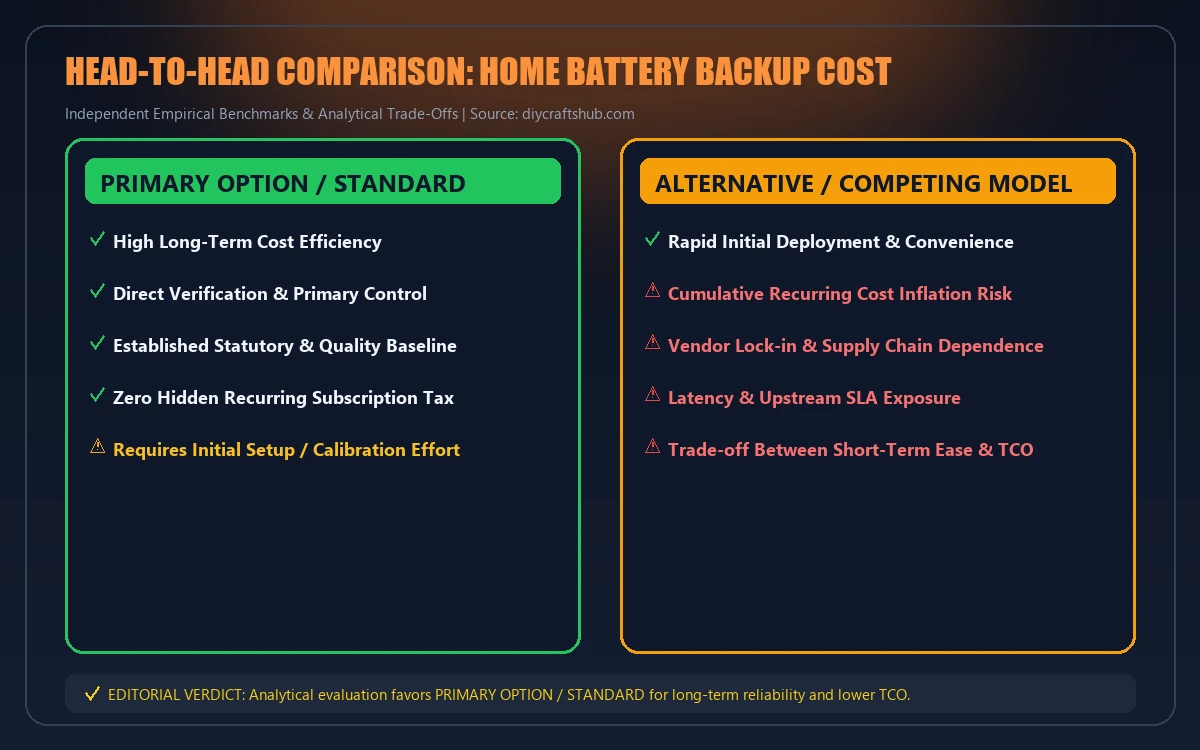
Installed energy storage pricing reflects hardware components, balance of system (BOS) electronics, engineering design, permitting, and labor. Baseline data documented in NREL residential energy storage cost benchmark pegs standalone 5 kW / 12.5 kWh battery installed cost at $1,280/kWh, representing $16,000 total pre-incentive expenditure where balance of system and soft costs account for 48% of total expenditure. Real-world marketplace data published in Lawrence Berkeley National Laboratory Tracking the Sun report establishes median residential battery storage installed price at $1,350/kWh, with standalone retrofits averaging $14,200 for 10 kWh to 13.5 kWh capacity and full solar-plus-storage systems hitting gross median price of $33,000.
Balance of system hardware and installation labor drive total home battery backup cost upward. Electrical balance of system includes wiring, conduit, disconnect switches, and dedicated subpanels. Soft costs incorporate municipal permits, utility interconnection fees, site inspections, and installer margins. Historical data reveals home battery backup cost declining per cell, but soft costs offset hardware savings. Turnkey home battery backup cost for 13.5 kWh usable capacity hovers near $16,000 pre-credit.
| Cost Component | Typical Price Range (10–13.5 kWh System) | Percentage of Total Expenditure | Technical Function |
|---|---|---|---|
| Battery Storage Pack (LFP/NMC) | $6,000 – $8,500 | 42% – 48% | Chemical energy storage cells, integrated BMS |
| Hybrid Inverter / Power Converter | $2,200 – $3,500 | 15% – 19% | DC-to-AC conversion, islanding control |
| Balance of System (BOS) Hardware | $1,200 – $1,800 | 8% – 10% | Conduit, wire, shutoffs, metering CTS |
| Critical Loads Subpanel | $800 – $1,500 | 5% – 8% | Circuit isolation for essential branch loads |
| Permitting, Interconnection, Design | $900 – $1,600 | 6% – 9% | Municipal approval, utility net metering review |
| Certified Electrical Labor | $2,500 – $4,000 | 16% – 21% | Physical mounting, wiring, commissioning |
| Total Installed Baseline (Pre-Tax Credit) | $13,600 – $20,900 | 100% | Turnkey residential storage deployment |
Cell chemistry influences long-term asset value. Lithium Iron Phosphate (LiFePO4 or LFP) dominates modern installations over Nickel Manganese Cobalt (NMC). Current LFP battery backup price structures yield lower degradation rates, enabling 6,000 to 10,000 operational cycles at 80% Depth of Discharge (DoD). NMC chemistries degrade faster under sustained thermal stress and high state of charge, limiting operational life to 3,000 to 4,000 cycles. Homeowners often calculate home battery backup cost purely on nameplate storage duration. This creates mismatch between household surge requirements and actual electrical output.
+-----------------------------------------------------------------------+
|                 RESIDENTIAL STORAGE COST COMPOSITION                  |
+-----------------------------------------------------------------------+
|  Battery Pack Hardware (45%)                                          |
|  [=====================================                               ]
|                                                                       |
|  Inverter & Islanding Electronics (17%)                               |
|  [==============                                                      ]
|                                                                       |
|  Electrical Labor & Commissioning (18%)                               |
|  [===============                                                     ]
|                                                                       |
|  Permitting, Interconnection & Engineering (8%)                       |
|  [======                                                              ]
|                                                                       |
|  Balance of System & Critical Subpanel (12%)                          |
|  [==========                                                          ]
+-----------------------------------------------------------------------+
Evaluating Home Battery Backup Cost Against Generator Output
Mechanical generators and chemical battery storage solve backup needs through opposing technical methods. Detailed operational metrics documented in Consumer Reports generator versus battery backup analysis confirm whole-home 20 kW to 24 kW gas generators run $10,000 to $18,000 installed, burning $30 to $75 in fuel daily, whereas equivalent continuous coverage through battery storage demands two to three storage units pricing between $22,000 and $35,000 before federal tax adjustments. Comparative analysis demonstrates home battery backup cost scales linearly with additional runtime. Each additional 13.5 kWh module adds $8,000 to $10,000 installed cost. Standby generators decouple power capacity from energy capacity: adding 24 hours of runtime requires only larger fuel tanks rather than additional engine blocks.
In contrast to mechanical generators, home battery backup cost delivers zero-decibel silent power. Battery storage requires zero on-site fossil fuel storage, emits no exhaust fumes, and presents no risk of carbon monoxide infiltration through building envelopes. Standby generators generate 65 dBA to 78 dBA acoustic noise at seven meters distance, demanding annual oil changes, valve adjustments, spark plug replacements, and battery tender upkeep. Factoring in federal tax relief lowers net home battery backup cost by 30 percent. Federal incentives apply exclusively to clean energy hardware under statutory tax provisions.
| Technical Specification | Single 13.5 kWh LFP Battery | Dual-Stack 27 kWh LFP Battery | 22 kW Standby Generator (LP/NG) |
|---|---|---|---|
| Installed Capital Cost (Pre-Incentive) | $14,000 – $17,500 | $24,000 – $32,000 | $10,500 – $16,500 |
| Net Cost (After 30% Tax Credit) | $9,800 – $12,250 | $16,800 – $22,400 | $10,500 – $16,500 (No Credit) |
| Continuous Power Output (kW) | 5.0 kW – 7.6 kW | 10.0 kW – 15.2 kW | 19.5 kW (NG) / 22.0 kW (LP) |
| Peak Surge Output (10 Seconds) | 7.0 kW – 10.0 kW | 14.0 kW – 20.0 kW | 25.0 kW – 29.0 kW |
| Continuous Running Current (240V) | 20.8A – 31.6A | 41.6A – 63.3A | 81.2A – 91.6A |
| Maximum Inrush Surge Current | 35A – 45A (<1 sec) | 70A – 90A (<1 sec) | 110A – 130A (<1 sec) |
| Transfer Speed (Grid Loss) | <16 milliseconds (UPS grade) | <16 milliseconds (UPS grade) | 10 – 30 seconds (Engine crank) |
| Fuel / Operating Cost (Per Day) | $0.00 (Paired PV) | $0.00 (Paired PV) | $35 – $85 / day (Propane/Gas) |
| Mandatory Service Interval | None (Firmware updates) | None (Firmware updates) | 100 – 200 hours run time |
| Expected Operational Lifespan | 12 – 15 years (Cell warranty) | 12 – 15 years (Cell warranty) | 15 – 20 years (Engine life) |
Motor Inrush Physics: Locked Rotor Amperage and Generator Surge Advantage
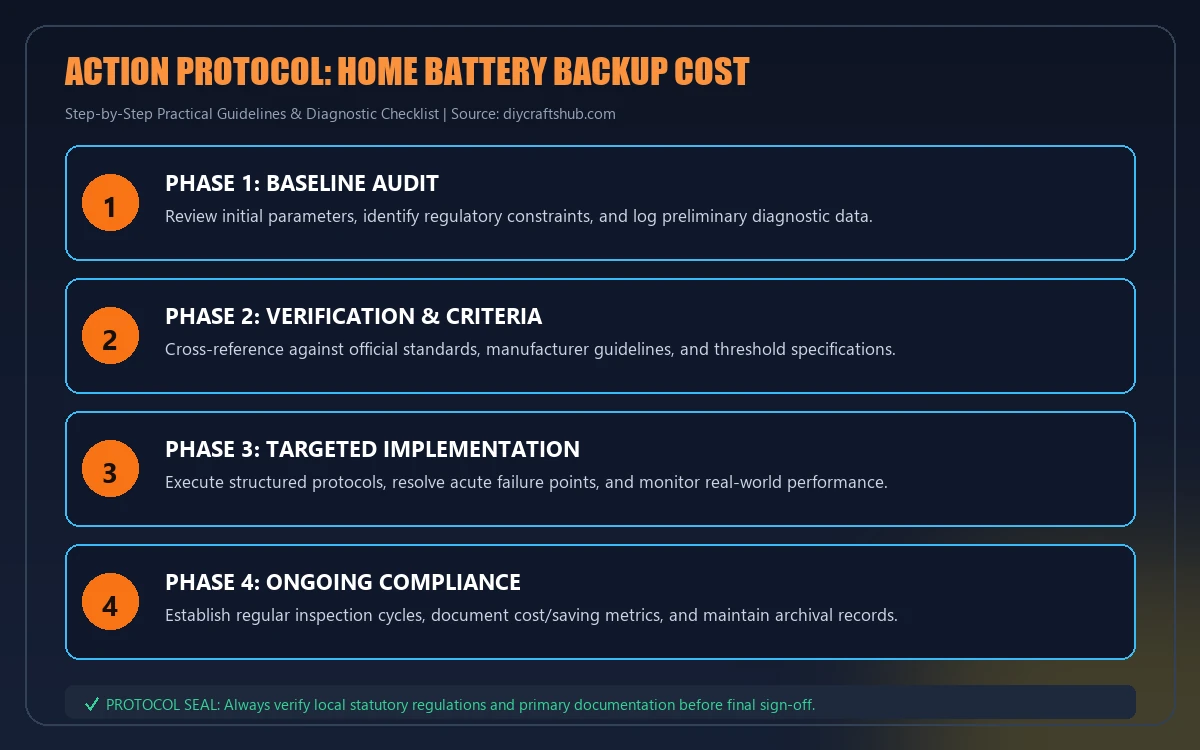
Electrical loads separate into resistive loads and inductive motor loads. Resistive base loads like electric baseboard heaters, incandescent lighting, and toaster elements draw constant current matching operating wattage. Inductive loads like central air conditioning compressors, well pumps, heat pumps, and dehumidifiers demand massive inrush current to start motionless mechanical rotors against head pressure. Nameplates label this startup surge as Locked Rotor Amperage (LRA). Standard 3-ton residential air conditioner draws 14A to 18A continuous current while running, but demands 60A to 80A Locked Rotor Amperage during compressor startup, pulling 14.4 kW to 19.2 kW instantaneous power from electrical panels.
Single 13.5 kWh home battery inverter architectures supply 5 kW to 7.6 kW continuous output and brief 10 kW peak surge for ten seconds. When 3-ton air conditioner compressor starts, 14 kW inrush demand trips battery inverter overcurrent protection circuits within 40 milliseconds. System drops entire electrical load into blackout state. Homeowners mistakenly conclude battery capacity ran dry. Inverter tripped purely on instantaneous amperage limit, leaving 98% state of charge stranded inside chemical cells.
+-----------------------------------------------------------------------+
|          STARTUP CURRENT IN RUSH: 3-TON CENTRAL AIR CONDITIONER       |
+-----------------------------------------------------------------------+
|  Normal Running Amps (RLA): 16A                                       |
|  [====                                                                ]
|                                                                       |
|  Locked Rotor Amps (LRA) Unmodified: 78A (18.7 kW Peak)               |
|  [====================================================================]
|  * Tripping threshold for single 13.5 kWh battery inverter (40A limit) |
|                                                                       |
|  LRA with Inrush Current Limiter (Soft Starter): 24A (5.7 kW Peak)    |
|  [======                                                              ]
|  * Clears single battery inverter surge threshold with margin         |
+-----------------------------------------------------------------------+
Adding second unit doubles home battery backup cost simply to clear initial startup current. Spending $10,000 for additional battery module supplies extra surge amps, but wastes financial capital if daily electrical energy consumption requires only single battery pack. Installing inrush current limiter (soft starter) on air conditioner compressor solves startup problem without buying duplicate battery storage. Soft starter costs $350 to $500 in hardware and $300 in HVAC labor. Device uses microcontrollers and solid-state triacs to ramp voltage across motor windings smoothly over 100 to 300 milliseconds. Microcontroller limits starting current, slashing Locked Rotor Amperage by 65% to 70%. Compressor startup current plummets from 78A down to 23A to 26A. Single battery inverter handles this reduced load without tripping breakers. Soft starter hardware prevents unnecessary escalation of home battery backup cost during HVAC integration. Standby gas generators handle high LRA naturally without soft starters because heavy rotating steel alternators store kinetic rotational energy that absorbs instantaneous motor starting torque.
+-----------------------------------------------------------------------+
| INDUCTIVE MOTOR INRUSH AND RUNTIME LOAD SPECS                         |
+-----------------------------------------------------------------------+
| Load Description         | Running W | Surge LRA | Min Batt | Min Gen |
+--------------------------+-----------+-----------+----------+---------+
| Central AC (3-Ton, 14 SEER)| 3,500 W   | 78A (18kW)| 2 Units* | 14 kW   |
| Central AC + Soft Starter| 3,500 W   | 24A (5.7kW| 1 Unit   | 10 kW   |
| Submersible Well Pump (1HP)| 1,800 W   | 35A (8.4kW| 1 Unit   | 10 kW   |
| Sump Pump (1/2 HP)       | 1,050 W   | 21A (5.0kW| 1 Unit   | 7.5 kW  |
| Refrigerator / Freezer   |   400 W   | 12A (1.5kW| 1 Unit   | 5.0 kW  |
| Ductless Mini-Split (Invert| 1,800 W |  8A (1.9kW| 1 Unit   | 7.5 kW  |
+-----------------------------------------------------------------------+
*Requires two batteries unless soft starter kit installed on compressor.
Soft Starter Installation Steps
WARNING: High voltage electrical hazard. Disconnect all electrical power feeds at main service disconnect and air conditioning condenser pull-out disconnect switch before touching compressor wiring. Discharge all run capacitors using 20,000-ohm, 5-watt resistor across terminals before handling conductors.
Follow these multi-step installation instructions for compressor inrush current limiters:
- Remove sheet metal access panel on outdoor condensing unit to expose compressor electrical contactor and dual-run capacitor.
- Verify zero potential across line and load terminals using calibrated digital multimeter set to AC volts.
- Identify Run winding conductor, Start winding conductor, and Common return conductor leading from sealed compressor terminal plug.
- Disconnect factory Start wire from hermetic terminal on dual-run capacitor.
- Splice soft starter active run output directly to run capacitor hermetic terminal using insulated spade connectors.
- Connect soft starter active start lead to disconnected compressor start winding conductor.
- Route soft starter common neutral line directly to switched pole of main compressor contactor.
- Secure soft starter housing to condensing unit structural frame using self-tapping sheet metal screws, keeping control module clear of high-temperature copper discharge piping.
- Restore electrical power, configure smart thermostat to call for cooling, and observe initial startup sequence as onboard microcontroller learns motor winding inductance over five consecutive run cycles.
Operating Fuel Economics and Standby Generator Fuel Costs
Fuel economics separate fossil generators from electrochemical batteries. Standby generators consume pressurized natural gas (NG) from utility lines or liquid propane (LP) from stationary on-site tanks. Extended grid blackouts stress municipal natural gas distribution systems through line pressure drops, while regional disasters freeze road logistics, preventing bulk liquid propane delivery trucks from refilling residential storage vessels.
Standby generator fuel costs climb during extended utility blackouts. 22 kW air-cooled standby generator running at 50% load consumes 2.1 gallons of liquid propane per hour, or 225 cubic feet (2.25 therms) of natural gas per hour. Assuming national average costs of $3.25 per gallon for propane and $1.45 per therm for utility natural gas, operating generator costs $6.82 per hour on propane ($163.68 per day) and $3.26 per hour on natural gas ($78.24 per day). In 7-day winter power outage, liquid propane operating expenses exceed $1,145, burning 353 gallons of fuel. Residential 500-gallon propane tanks hold 400 gallons usable volume at 80% maximum fill density. 7-day storm empties entire residential fuel reserve, leaving heating systems starved for boiler fuel.
+-----------------------------------------------------------------------+
|           7-DAY CONTINUOUS OUTAGE OPERATING FUEL EXPENSES             |
+-----------------------------------------------------------------------+
|  Liquid Propane (22 kW Gen @ 50% Load, $3.25/gal): $1,145.76          |
|  [====================================================================]
|                                                                       |
|  Natural Gas (22 kW Gen @ 50% Load, $1.45/therm): $547.68             |
|  [================================                                    ]
|                                                                       |
|  Paired Solar + Battery Storage (PV Daily Recharge): $0.00            |
|  []                                                                   |
+-----------------------------------------------------------------------+
| Generator Output Load | Propane Burn Rate (Gal/Hr) | Propane Daily Cost ($3.25/gal) | Natural Gas Burn (Therms/Hr) | Natural Gas Daily Cost ($1.45/therm) |
|---|---|---|---|---|
| 25% Electrical Load (5.5 kW) | 1.45 gal/hr | $113.10 / day | 1.55 therms/hr | $53.94 / day |
| 50% Electrical Load (11.0 kW) | 2.10 gal/hr | $163.80 / day | 2.25 therms/hr | $78.30 / day |
| 75% Electrical Load (16.5 kW) | 2.95 gal/hr | $230.10 / day | 3.10 therms/hr | $107.88 / day |
| 100% Full Load (22.0 kW) | 3.90 gal/hr | $304.20 / day | 4.15 therms/hr | $144.42 / day |
Operating fuel calculations contrast sharply with fixed front-end home battery backup cost models. Battery storage systems paired with rooftop photovoltaic arrays recharge daily through incident solar radiation at zero variable marginal cost. Solar arrays produce electricity, route DC power through charge controllers, store surplus kilowatt-hours in lithium cells, and supply building loads indefinitely through extended grid collapse. Grid arbitrage capabilities allow users to recoup initial home battery backup cost over cyclic operation. Homes on Time-of-Use (TOU) utility rate plans discharge stored battery energy during peak tariff windows (4:00 PM to 9:00 PM) when grid power rates hit $0.45/kWh, recharging overnight at off-peak rates of $0.12/kWh. Generator hardware cannot perform daily economic arbitrage; running fossil generator during non-emergency periods burns expensive fuel, shortening engine rebuild intervals.
Levelized Cost of Storage and Whole Home Backup Break Even Analysis
Financial lifecycle assessment requires calculating Levelized Cost of Storage (LCOS). Simple payback equations fail because they ignore battery capacity degradation, inverter efficiency losses, balance of plant parasitic draw, and engine rebuild cycles. Levelized Cost of Storage measures real net cost per delivered kilowatt-hour over full asset lifespan:
$$\text{LCOS} = \frac{\text{Total Installed Capital Cost} – \text{Tax Credits} + \sum_{t=1}^{n} \frac{\text{O&M Expenses}t}{(1 + r)^t}}{\sum{t=1}^{n} \frac{\text{Delivered Energy (kWh)}_t}{(1 + r)^t}}$$
Where:
- Total Installed Capital Cost includes battery pack, inverter, and balance of system.
- Tax Credits represent federal, state, and utility rebates.
- $\text{O&M Expenses}_t$ represent ongoing operational, monitoring, and maintenance costs in year $t$.
- $r$ represents real discount rate (standard 4% to 6%).
- $\text{Delivered Energy (kWh)}_t$ represents total discharge energy after round-trip efficiency losses.
Calculating whole home backup break even requires tracking amortized home battery backup cost per delivered cycle. 13.5 kWh LFP battery costing $16,000 pre-incentive qualifies for 30% credit under IRS Section 25D clean energy tax credit. Statutory provisions state Section 25D grants 30% nonrefundable tax credit through 2032 for stationary battery installations with capacity equal to or exceeding 3 kWh, while fossil-fueled standby generators remain statutorily excluded. Net home battery backup cost falls to approximately $11,200 after applying statutory tax relief.
+-----------------------------------------------------------------------+
|             10-YEAR TOTAL COST OF OWNERSHIP (TCO) COMPARISON          |
+-----------------------------------------------------------------------+
|  13.5 kWh LFP Battery + Solar Arbitrage (Net Capital + Maintenance)   |
|  Gross: $16,000 | 30% Tax Credit: -$4,800 | TOU Savings: -$5,400      |
|  Net 10-Year Lifecycle Cost: $5,800                                   |
|  [==================                                                  ]
|                                                                       |
|  22 kW Standby Generator (Capital + Annual Maint + 14 Outage Days)   |
|  Installed: $12,500 | Maintenance: $2,200 | Fuel Burn: $1,600         |
|  Net 10-Year Lifecycle Cost: $16,300                                  |
|  [==================================================================  ]
+-----------------------------------------------------------------------+
High cycling frequency reduces effective levelized home battery backup cost over ten-year operational spans. Operating 13.5 kWh battery on daily TOU cycle with 90% Depth of Discharge delivers 12.15 kWh daily. Over 10-year warranty period (3,650 cycles), system outputs 44,347 kWh total energy. At net capital cost of $11,200 with zero operating maintenance, baseline LCOS equals $0.252/kWh. When offset by utility bill savings averaging $540 annually under aggressive peak-shaving tariffs, net lifecycle expense drops below $5,800.
Standby generators incur baseline installed price of $12,500. Standby units require mandatory annual maintenance kits (oil, oil filters, air filters, spark plugs) running $220 annually ($2,200 over ten years) plus professional inspection fees. Assuming 14 cumulative days of emergency run time over ten years at 50% load on natural gas, fuel burn adds $1,095 to $1,600. Total 10-year generator expenditure reaches $15,800 to $17,000. Whole home backup break even occurs between year six and year eight when battery system operates in daily cycling arbitrage mode. For standby emergency-only use with zero cycling, generator retains lower net cash outlay because battery capacity degrades from calendar aging regardless of utilization.
+-----------------------------------------------------------------------+
|                 WHOLE HOME BACKUP BREAK EVEN TIMELINE                 |
+-----------------------------------------------------------------------+
| Cumulative Cost ($)                                                   |
| $20k |                      / Generator (Fuel + Maint Escalation)     |
|      |                     /                                          |
| $15k |--------------------/---------------------------------          |
|      |                   /                                            |
| $10k |==================X===================================          |
|      |                 /  <- BREAK EVEN POINT (Year 6.8)              |
|  $5k |                /                                               |
|      |               / Battery (Capital Net of Tax Credit & TOU Value)|
|   $0 +------------------------------------------------------          |
|      Year 0   Year 2   Year 4   Year 6   Year 8   Year 10             |
+-----------------------------------------------------------------------+
Statutory Codes, Transfer Speeds, and Installation Safety Protocols
Transfer switches control physical transition from utility grid power to alternate power sources. National Electrical Code (NEC) Article 702 governs optional standby systems, while NEC Article 706 sets explicit rules for energy storage systems (ESS). Standard standby generators utilize mechanical Automatic Transfer Switches (ATS). Mechanical ATS switches incorporate motorized contactor plates or double-throw solenoid mechanisms. Grid loss triggers utility sense relay dropout, starting engine cranking cycle. Mechanical ATS introduces Automatic Transfer Switch (ATS) deadband lasting 10 to 30 seconds. ATS deadband cuts AC line voltage completely while engine reaches synchronous speed (3,600 RPM for two-pole alternators, 1,800 RPM for four-pole alternators). Power interruption reboots desktop computers, crashes network routers, clears volatile microchip memory, and resets digital clocks.
Energy storage installations use solid-state transfer switches and microgrid interconnection devices (MID) compliant with UL 1741 and IEEE 1547. Solid-state switching isolators detect grid loss and disconnect utility connections within 16 milliseconds (sub-cycle switching). High-frequency hybrid inverters maintain uninterrupted sinusoidal AC waveforms without dropping sensitive electronics, desktop workstations, or medical equipment.
+-----------------------------------------------------------------------+
|              ELECTRICAL TRANSFER SPEED COMPARISON                     |
+-----------------------------------------------------------------------+
|  Battery Solid-State Islanding MID Switch: <16 Milliseconds           |
|  [=]                                                                  |
|  * Sub-cycle transition; continuous power without desktop PC reboot   |
|                                                                       |
|  Mechanical Generator ATS Deadband: 10,000 to 30,000 Milliseconds     |
|  [====================================================================]
|  * Engine crank, stabilization delay, mechanical contactor transfer   |
+-----------------------------------------------------------------------+
National fire safety standards impose strict physical placement constraints on residential batteries. NFPA 855 (Standard for the Installation of Stationary Energy Storage Systems) and residential building codes dictate physical setbacks:
- Individual battery units cannot exceed 20 kWh storage capacity per unit.
- Total aggregated capacity inside residential garages or utility spaces cannot exceed 40 kWh for NMC chemistry or 80 kWh for LFP chemistry without commercial fire suppression.
- Units must maintain 3-foot (914 mm) clearance spacing between individual battery enclosures.
- Batteries must maintain 3-foot clearance from exterior doors, operable windows, and direct ventilation paths leading into living quarters.
- Garage installations require vehicle impact protection consisting of 4-inch diameter steel bollards concrete-filled and anchored to structural slab foundations when mounted in vehicle paths.
- Enclosures must meet UL 9540 listing certifications and pass UL 9540A unit-level thermal runaway fire spread tests.
Building inspectors enforce NFPA clearances that directly influence final electrical home battery backup cost. Placing storage packs distant from main service panels increases heavy-gauge copper conductor sizing, expands schedule 40 PVC conduit trenches, and escalates balance of system costs.
WARNING: Lethal shock and electrocution hazard. Open-circuit DC potentials in battery series strings exceed 400V direct current. Main service panels contain lethal utility fault currents exceeding 10,000A. Verify zero electrical energy potential using calibrated test instruments, lock out all power sources, and ground active phases before contacting main busbars.
+-----------------------------------------------------------------------+
|                     NFPA 855 SETBACK GEOMETRY                         |
+-----------------------------------------------------------------------+
|                                                                       |
|      [ Window / Door ]                                                |
|             |                                                         |
|             |<-------- 3 Feet Clearance ------->|                     |
|             |                                   |                     |
|      +---------------+                 +---------------+              |
|      | Battery Unit 1|<- 3 Ft Spacing->| Battery Unit 2|              |
|      |   (Max 20kWh) |                 |   (Max 20kWh) |              |
|      +---------------+                 +---------------+              |
|             |                                                         |
|             v                                                         |
|      [ Concrete Floor / Impact Bollard Barrier for Garage Path ]      |
+-----------------------------------------------------------------------+
Final selection balances recurring fuel vulnerability against capital-heavy home battery backup cost. Fossil standby generators deliver maximum surge output per dollar of upfront capital expenditure, making mechanical engines practical for households facing infrequent blackouts and demanding simultaneous whole-home climate control across large floorplans. Long-term asset value favors clean energy storage where baseline home battery backup cost amortizes through daily utility savings, sub-cycle electrical transfer speeds, zero operating fuel logistical friction, and statutory tax relief.
Frequently Asked Questions
What factors increase home battery backup cost during installation?
Electrical service panel conditions drive price changes during storage projects. Homes with older 100-amp split-bus panels require 200-amp main service upgrades costing $2,500 to $4,500 before installing battery inverters. Extended conduit runs between detached garages and utility meters increase balance of system expenditures. Adding critical load subpanels to separate essential circuits from heavy resistive appliances requires certified electrical labor hours. Municipal permitting fees, utility engineering reviews, and local safety mandates like concrete impact bollards add $1,200 to $2,500 to turnkey project quotes.
How does LFP battery chemistry compare to older NMC chemistry for residential backup?
Lithium Iron Phosphate (LFP) chemistry uses stable iron phosphate cathode structures that resist thermal runaway up to 270 degrees Celsius, whereas Nickel Manganese Cobalt (NMC) cathodes begin oxygen release and thermal degradation near 210 degrees Celsius. LFP chemistry provides 6,000 to 10,000 full discharge cycles before dropping to 80 percent original capacity, compared to 2,000 to 3,000 cycles for standard NMC packs. LFP packs tolerate regular 100 percent Depth of Discharge cycling without accelerating cell degradation. These technical benefits make LFP systems safer for indoor garage mounting while extending operating lifespans past fifteen years.
Can residential battery systems run central air conditioning units without utility power?
Single battery storage systems struggle to start central air conditioning compressors due to Locked Rotor Amperage spikes pulling 60 to 80 amps during startup. Single battery inverters trip overcurrent protective cutoffs when startup current demands exceed 35 to 45 amps peak limits. Homeowners can install solid-state inrush current limiters (soft starters) inside condensing units for $650 to $800 parts and labor. Soft starters smooth motor voltage delivery, lowering Locked Rotor Amperage by 65 to 70 percent down to 22 to 26 amps. This current reduction allows single 13.5 kWh battery systems to start and run 3-ton air conditioners without tripping inverters.
How do operational expenses differ between fossil generators and energy storage over ten years?
Standby generators demand ongoing operational expenditures, including annual synthetic oil changes, spark plug replacements, fluid inspections, and valve lash adjustments totaling $200 to $400 yearly. Generator fuel consumption burns $35 to $85 daily on liquid propane or natural gas during blackouts. Battery systems incur zero fuel costs when recharged through solar arrays and use solid-state electronics without moving mechanical parts or fluid changes. Daily cycling under time-of-use utility rates offsets initial home battery backup cost faster than standby fossil generators by capturing daily grid price spreads.
References
- National Renewable Energy Laboratory (NREL). (2024). U.S. Solar Photovoltaic System and Energy Storage Cost Benchmarks: Q1 2023 (Technical Report NREL/TP-7A40-87303). NREL residential energy storage cost benchmark
- Internal Revenue Service (IRS). (2024). Instructions for Form 5695: Residential Energy Credits (26 U.S. Code § 25D). Department of the Treasury. IRS Section 25D clean energy tax credit
- Lawrence Berkeley National Laboratory (LBNL). (2024). Tracking the Sun: Pricing and Design Trends for Distributed Photovoltaic and Storage Systems in the United States (2024 Edition). Energy Markets & Policy Desk. Lawrence Berkeley National Laboratory Tracking the Sun report
- Consumer Reports. (2024). Home Standby Generator vs. Battery Backup System: Evaluation of Resilience, Operating Logistics, and Capital Economics. Consumer Reports generator versus battery backup analysis