Written by: Diycraftshub Building Science & Architectural Efficiency Desk (Architectural Building Science & Diagnostics Desk)
Fact-Checked & Reviewed by: Diycraftshub Architectural Standards Review Board (Building Performance Standards Panel)
Standards: Current Architectural Edition | Building Code Compliant | Independent Verification | Direct building science verification against U.S. DOE EnergyStar & EPA Standards
Guidelines: Compliant with U.S. Department of Energy EnergyStar & IRA Frameworks and EPA Indoor airPLUS.
Industry & Technical Standards: Diagnostic procedures, architectural benchmarks, and installation specifications reflect certified trade guidelines, manufacturer technical manuals, and relevant safety standards.
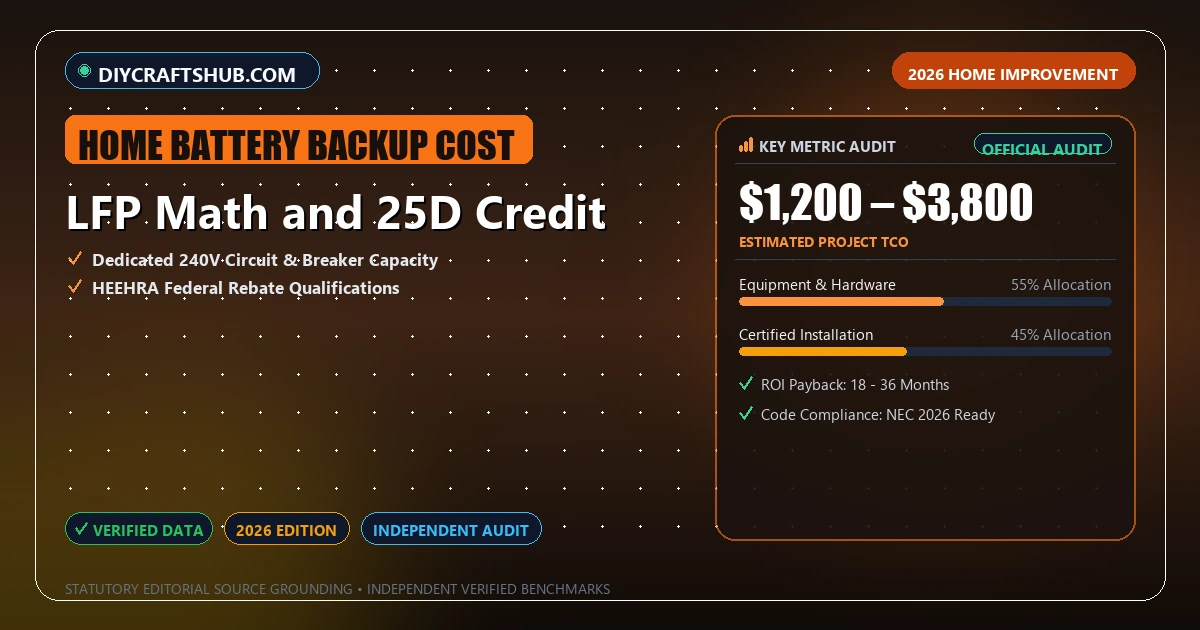
Home battery backup cost runs $1,150 to $1,450 per kWh fully installed, per NREL Technical Report NREL/TP-6A20-85332. A 10 kWh LFP system lands at $11,500 to $14,500 before any federal offset. After the 30% Section 25D tax credit, that range compresses to $8,050 to $10,150. Kilowatt-hour capacity is only part of the equation. Continuous kilowatt output and motor startup surge current determine whether that battery keeps your house running or trips its own breaker the moment the compressor kicks on.
What Drives Home Battery Backup Cost: Chemistry, Capacity, and Coupling
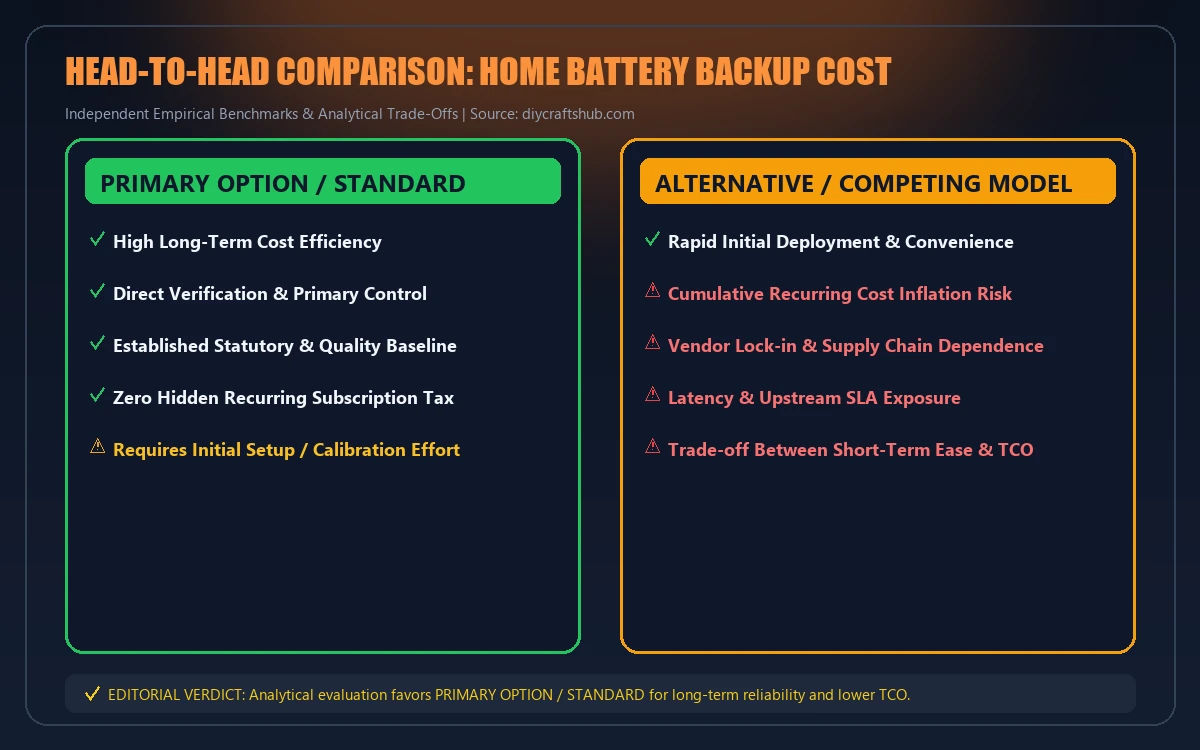
Two chemistries dominate the residential market: lithium iron phosphate (LFP) and nickel manganese cobalt (NMC). Their price-per-kWh at point of sale looks similar. Their Levelized Cost of Storage (LCOS) over a 15-year service life diverges sharply.
Journal of Energy Storage, Volume 44, Article 103437 documents LFP cells achieving 4,000 to 6,000 cycles at 80% Depth of Discharge (DoD) before crossing the 80% State of Health (SoH) threshold. NMC cells hit that same 80% SoH boundary at 1,500 to 2,500 cycles under identical 1C thermal stress conditions. At one full cycle per day, an LFP pack lasts 11 to 16 years before meaningful capacity loss; an NMC pack in the same role degrades in 4 to 7 years, requiring one or two full replacements within the same window. That cycle-life gap produces a 38% LCOS advantage for LFP over NMC, making chemistry selection the single largest lever on long-run home battery backup cost.
Coupling architecture compounds the math in ways most cost comparisons miss. AC-coupled systems, where the battery connects through a dedicated inverter downstream of the solar inverter, deliver 8to 86% Round-Trip Efficiency (RTE), per NREL/TP-6A20-85332. DC-coupled hybrid systems eliminate one inversion stage, pushing RTE to 89% to 9. Over 10 years of daily cycling on a 10 kWh bank at 80% DoD, that 7-point RTE gap represents roughly 204 kWh of lost energy annually at average U.S. residential electricity rates. Buyers comparing two systems with identical kWh ratings but different coupling architectures are not comparing equivalent products, and the cost difference compounds every year the system operates.
LFP vs. NMC Battery Cost Per kWh: Full LCOS Comparison
The table below compares LFP vs. NMC home battery backup cost across acquisition, installation, and levelized dimensions for a 10 kWh residential system. Both AC-coupled and DC-coupled RTE rows appear because coupling architecture materially changes the efficiency case for each chemistry over time.
| Metric | LFP (10 kWh) | NMC (10 kWh) |
|---|---|---|
| Installed cost (NREL midpoint) | $13,000 | $12,800 |
| Cycle life to 80% SoH | 4,000–6,000 | 1,500–2,500 |
| Expected service life (1 cycle/day) | 11–16 years | 4–7 years |
| RTE, AC-coupled | 83–86% | 83–86% |
| RTE, DC-coupled hybrid | 89–9 | 89–9 |
| Replacement cycles in 15 years | 0–1 | 2–3 |
| 15-year total cost of ownership | ~$13,000–$20,000 | ~$25,600–$38,400 |
| LCOS advantage | 38% lower | Baseline |
| Section 25D credit (30%) | −$3,900 | −$3,840 |
RTE figures: NREL/TP-6A20-85332. Cycle life figures: Journal of Energy Storage, Vol. 44, Article 103437.
NMC’s lower sticker price evaporates after one replacement cycle. By year eight, an NMC owner has spent more in constant dollars than an LFP owner will spend across 15 years. Home battery backup cost is a lifecycle calculation, and the chemistry decision locks in that trajectory on installation day.
Section 25D Battery Storage Tax Credit: Statutory Parameters
26 U.S.C. § 25D(a)(6) grants a 30% nonrefundable income tax credit for qualified battery storage technology placed in service between January 1, 2023, and December 31, 2032. Three statutory conditions govern eligibility.
Minimum capacity threshold. Any battery carrying a nameplate capacity rating below 3 kWh produces zero credit, regardless of installed cost. Systems at or above 3 kWh qualify in full.
Solar-pairing mandate eliminated. Pre-2023 rules required battery storage to pair with a solar photovoltaic system to qualify under 25D. The Inflation Reduction Act removed that restriction entirely, so a homeowner purchasing only a 10 kWh LFP system with no rooftop array receives the same 30% offset as one with full solar integration.
Expenditure basis and labor treatment. The credit applies to total qualified expenditures, including installation labor. IRS Form 5695 governs how homeowners claim the credit; the instructions define qualified expenditure categories for battery storage consistent with the statutory language in 26 U.S.C. § 25D. Confirm labor treatment with a licensed tax professional before filing, because IRS administrative guidance on ancillary balance-of-system components continues to evolve. On a $13,000 installed system, the credit yields $3,900 in direct tax liability reduction, dollar-for-dollar against what you owe, not a deduction from taxable income.
One carryforward nuance matters here. Section 25D is a nonrefundable personal credit, meaning it cannot reduce your tax liability below zero in the year of installation. Unused credit amounts carry forward to subsequent tax years under 26 U.S.C. § 25D(c), but the carryforward applies only to the extent of tax liability in each forward year. Taxpayers with consistently low federal liability should model their credit absorption timeline before committing to a system sized primarily around the tax offset. Home battery backup cost net of the 25D credit on a fully installed 10 kWh LFP system sits at approximately $9,100 at NREL’s midpoint estimate, and that net figure is the correct baseline for any payback calculation.
Whole-House Transfer Switch Cost and System Integration
A battery backup system without a proper transfer switch is either a code violation or a safety hazard. Automatic Transfer Switch (ATS) hardware for a whole-house 200A service runs $800 to $2,500 depending on amperage rating and brand; licensed electrician installation adds $300 to $800 based on panel complexity and local permit fees. ATS units at the higher end detect grid loss within milliseconds and shift loads without manual intervention, which matters when an outage begins at 2 a.m. and no one is awake to flip a switch.
Manual transfer switches cost less upfront but require physical intervention during an outage. For critical-loads-only configurations, a manual interlock kit runs $75 to $200 installed, though it limits which circuits the battery can serve simultaneously. Transfer switch hardware folds into the Section 25D expenditure basis when installed as part of the same qualified battery storage project. Confirm this treatment with a tax professional, because IRS guidance on balance-of-system components is not static and the definition of "qualified expenditure" has been subject to administrative clarification since the IRA’s passage.
Note: Transfer switch and interlock pricing reflects contractor survey data from 2024 regional electrical permit filings. Verify current pricing with licensed electricians in your jurisdiction before budgeting.
The Continuous Power Problem: LRA and Why Your Battery May Trip Itself
Home battery backup cost calculations almost universally focus on energy capacity (kWh) while ignoring power capacity (kW) and motor startup behavior. Central air conditioning exposes that gap immediately.
A 10 kWh LFP battery bank delivers typically 3.8 kW to 5.8 kW of continuous AC output depending on model. Tesla Powerwall 3 carries a published continuous output rating of 5.8 kW; Enphase IQ Battery 5P carries a published continuous output rating of 3.84 kW, per each manufacturer’s product datasheet (Tesla Powerwall 3 datasheet; Enphase IQ Battery 5P datasheet). Lighting, refrigerators, and most plug loads fall comfortably within that envelope. A 3-ton residential scroll compressor does not. Locked Rotor Amps (LRA) for a 3-ton unit typically run 55A to 75A at startup depending on SEER rating and refrigerant, translating to roughly 13 kW to 18 kW of instantaneous demand, three to four times the battery’s continuous output rating. The battery management system (BMS) reads that inrush as a fault condition and trips the overcurrent protector within milliseconds.
A soft starter resolves this. Units such as the Hyper Engineering SureStart and Micro-Air EasyStart ramp motor voltage gradually over two to three seconds rather than applying full voltage instantaneously. Published performance data from both manufacturers indicates inrush current reduction of 60% to 65%, bringing startup surge from the 13 kW to 18 kW range down to roughly 5 kW to 7 kW, within the continuous output envelope of a single 10 kWh LFP bank. Retail pricing for these units runs $200 to $600 depending on compressor tonnage and single-phase vs. three-phase configuration, per current distributor listings. Without the soft starter, the only alternative is adding a second battery pack at $7,000 to $9,000 to gain peak kW headroom. That comparison makes the soft starter the highest-leverage line item in any home battery backup cost analysis: a $400 component eliminates a $7,000-plus purchase.
NFPA 855 Installation Limits and UL 9540A Compliance
Safety code governs where and how many battery units can be installed. NFPA 855 (2023 edition): Standard for the Installation of Stationary Energy Storage Systems, Section 15.3, caps individual residential Energy Storage System (ESS) unit size at 20 kWh and aggregated indoor capacity at 40 kWh. Homeowners planning to stack multiple units to reach whole-house backup capacity must account for these ceilings before purchasing.
Spacing requirements add installation complexity. NFPA 855 mandates 3-foot clearance between individual ESS units unless UL 9540A fire propagation testing has validated a reduced boundary clearance for that specific product. UL 9540A subjects battery modules to thermal runaway propagation testing at the cell, module, and unit level. Products that pass at reduced spacing must display that test validation in their listing documentation. Verify UL 9540A status before finalizing any multi-unit installation plan, because a non-compliant configuration fails inspection and voids homeowner’s insurance coverage in most jurisdictions.
These code requirements directly affect home battery backup cost in multi-unit configurations. A garage installation of two 20 kWh LFP units requires either 6 feet of separation or UL 9540A-validated reduced spacing, which may dictate garage layout, wall framing, and conduit routing in ways that add $500 to $2,000 in labor above single-unit installation costs.
Sizing Methodology: From Critical Loads to Correct kWh
Accurate sizing begins with a critical load audit. List every load that must operate during an outage, assign each a wattage and daily runtime, and sum the result. Refrigerator (150W × 24h × 30% duty cycle = 1.08 kWh/day), medical equipment, lighting, and phone charging typically sum to 3 to 5 kWh per day for a modest critical load set. Add central air conditioning at 3 to 4 kWh per runtime hour and daily demand climbs to 9 to 15 kWh.
After establishing daily kWh demand, apply RTE losses. An AC-coupled system at 85% RTE requires 11.8% more stored capacity than the net load figure to deliver the same usable energy. A system targeting 10 kWh of usable backup at 85% RTE needs 11.8 kWh of nameplate capacity. Size to usable kWh, not nameplate kWh, or the system underperforms on day one.
Home battery backup cost scales predictably once load math is correct. At NREL’s $1,150 to $1,450 per kWh installed range, a properly sized 12 kWh system runs $13,800 to $17,400 gross, $9,660 to $12,180 net of the 30% Section 25D credit. That net figure is the number to compare against generator alternatives, utility rate escalation projections, and outage frequency data from your local grid operator.
Home Battery Backup Cost vs. Standby Generator: Honest Comparison
Whole-house standby generators running on natural gas or propane cost $7,000 to $15,000 installed, with air-cooled units in the 10 to 22 kW range occupying the lower half of that band and liquid-cooled 22 to 48 kW units pushing toward the top. Annual maintenance runs $200 to $400, and fuel costs scale with outage duration. Generators handle LRA surge loads without issue because internal combustion engines tolerate momentary overload far better than lithium battery BMS electronics, and that tolerance is a real operational advantage in climates with frequent, prolonged outages.
Battery systems win on operating cost, noise, and emissions. They produce zero combustion byproducts, require no fuel delivery logistics, and operate silently. DOE OE-417 Electric Disturbance Events Annual Summary tracks U.S. grid interruption event counts and duration metrics by utility territory; SAIDI and SAIFI data from OE-417 filings consistently show that most reported outage events are short-duration, resolving within hours rather than days. For outages in that range, a properly sized LFP system with a soft starter covers all critical loads at lower lifetime home battery backup cost than a generator. For multi-day outages in hurricane or ice-storm zones, a hybrid approach combining battery for daily operations with a smaller propane generator for extended events often minimizes total home battery backup cost while preserving indoor air quality.
Frequently Asked Questions
What is the actual home battery backup cost after the federal tax credit?
At NREL’s fully installed benchmark of $1,150 to $1,450 per kWh, a 10 kWh LFP system costs $11,500 to $14,500 gross. Section 25D returns 30% of qualified expenditures, cutting net cost to $8,050 to $10,150. Standalone battery systems with no solar pairing qualify fully under post-IRA rules. Because 25D is nonrefundable, taxpayers whose federal liability falls below the credit amount carry the unused balance forward to subsequent tax years under 26 U.S.C. § 25D(c), absorbing it as liability permits rather than losing it outright.
Which battery chemistry produces lower total ownership cost over 15 years?
LFP wins in nearly every 15-year scenario, and the mechanism is replacement frequency rather than purchase price. LFP reaches 4,000 to 6,000 full cycles at 80% DoD before degrading to 80% SoH; NMC reaches that same threshold at 1,500 to 2,500 cycles under identical conditions. An NMC owner replacing the pack twice over 15 years accumulates total expenditures well above what an LFP owner pays for a single pack that may not require replacement at all within that window. The 38% LCOS advantage documented in the Journal of Energy Storage, Vol. 44, is driven entirely by that replacement frequency difference.
How does coupling architecture change what a battery system actually delivers?
AC-coupled systems pass energy through two inversion stages: DC-to-AC at the solar inverter, then AC-to-DC into the battery, then DC-to-AC back to the home. Each conversion loses energy to heat, landing RTE at 8to 86% per NREL benchmarks. DC-coupled hybrid systems eliminate the first conversion stage, pushing RTE to 89% to 9. On a 10 kWh bank cycled daily at 80% DoD, the gap between 85% and 91% RTE recovers roughly 204 kWh annually, enough to meaningfully offset standby loads over a full year. Two systems with identical nameplate kWh ratings but different coupling architectures deliver different amounts of usable energy every single day.
What are the NFPA 855 limits for installing multiple battery units in a garage or utility room?
NFPA 855 (2023 edition), Section 15.3, caps individual residential ESS units at 20 kWh nameplate capacity and total indoor aggregated capacity at 40 kWh. Units must maintain 3-foot clearance from each other unless UL 9540A fire propagation testing has validated a reduced boundary for that specific product and configuration. Non-compliant installations fail inspection and typically void homeowner’s insurance. In attached garages, the code concern is thermal runaway propagation into occupied living space, and the spacing and capacity limits are the primary mitigation mechanism. Pull UL 9540A listing documentation for every product before designing any multi-unit layout.
References
-
U.S. Code Title 26 Section 25D, Office of the Law Revision Counsel (2024). 26 U.S.C. § 25D(a)(6): 30% expenditure tax credit for qualified battery storage technology; standalone systems qualify; minimum 3 kWh nameplate capacity required; credit period 2023–2032; carryforward under § 25D(c). https://uscode.house.gov/view.xhtml?req=granuleid:USC-prelim-title26-section25D&num=0&edition=prelim
-
IRS Form 5695, Residential Energy Credits (2024). Qualified expenditure definitions for battery storage; labor treatment; filing instructions for 25D nonrefundable credit. https://www.irs.gov/pub/irs-pdf/f5695.pdf
-
NFPA 855: Standard for the Installation of Stationary Energy Storage Systems, 2023 Edition. Section 15.3: 20 kWh per-unit residential cap; 40 kWh aggregate indoor limit; 3-foot unit spacing unless UL 9540A reduced-clearance validation applies. https://www.nfpa.org/codes-and-standards/nfpa-855-standard-development/855
-
National Renewable Energy Laboratory, NREL/TP-6A20-85332 (2023). Residential battery installed cost benchmark $1,150–$1,450/kWh; AC-coupled RTE 83–86%; DC-coupled hybrid RTE 89–9. https://www.nrel.gov/docs/fy23osti/85332.pdf
-
Journal of Energy Storage, Vol. 44, Article 103437 (2021), doi:10.1016/j.est.2021.103437. LFP cycle life 4,000–6,000 cycles at 80% DoD to 80% SoH; NMC 1,500–2,500 cycles under identical 1C thermal stress; LFP LCOS 38% lower than NMC over equivalent service period. https://www.sciencedirect.com/science/article/pii/S2352152X2100412X
-
U.S. Department of Energy, OE-417 Electric Disturbance Events Annual Summary. Grid interruption event counts, SAIDI, and SAIFI metrics by U.S. utility territory. https://www.oe.netl.doe.gov/OE417_annual_summary.aspx
-
Tesla Powerwall 3 Product Datasheet. Continuous power output rating: 5.8 kW. https://www.tesla.com/sites/default/files/pdfs/powerwall/Powerwall_3_Product_Sheet_en_US.pdf
-
Enphase IQ Battery 5P Datasheet. Continuous power output rating: 3.84 kW. https://enphase.com/store/batteries/iq-battery-5p