Written by: Diycraftshub Building Science & Architectural Efficiency Desk (Architectural Building Science & Diagnostics Desk)
Fact-Checked & Reviewed by: Diycraftshub Architectural Standards Review Board (Building Performance Standards Panel)
Standards: Current Architectural Edition | Building Code Compliant | Independent Verification | Direct building science verification against U.S. DOE EnergyStar & EPA Standards
Guidelines: Compliant with U.S. Department of Energy EnergyStar & IRA Frameworks and EPA Indoor airPLUS.
Industry & Technical Standards: Diagnostic procedures, architectural benchmarks, and installation specifications reflect certified trade guidelines, manufacturer technical manuals, and relevant safety standards.
Home battery backup cost in 2025 runs $10,000 to $22,000 fully installed before any incentives, with the IRS Section 25D credit slicing 30% off that figure for qualifying systems. That spread is wide because hardware accounts for barely 31% of total project spend. Understanding where the remaining 69% goes determines whether a storage retrofit pencils out or quietly hemorrhages capital.

Fully installed residential LFP battery system with inverter and automatic transfer switch. Installed cost benchmarks from NREL 2024 ATB.
What Drives Home Battery Backup Cost Beyond the Battery Pack
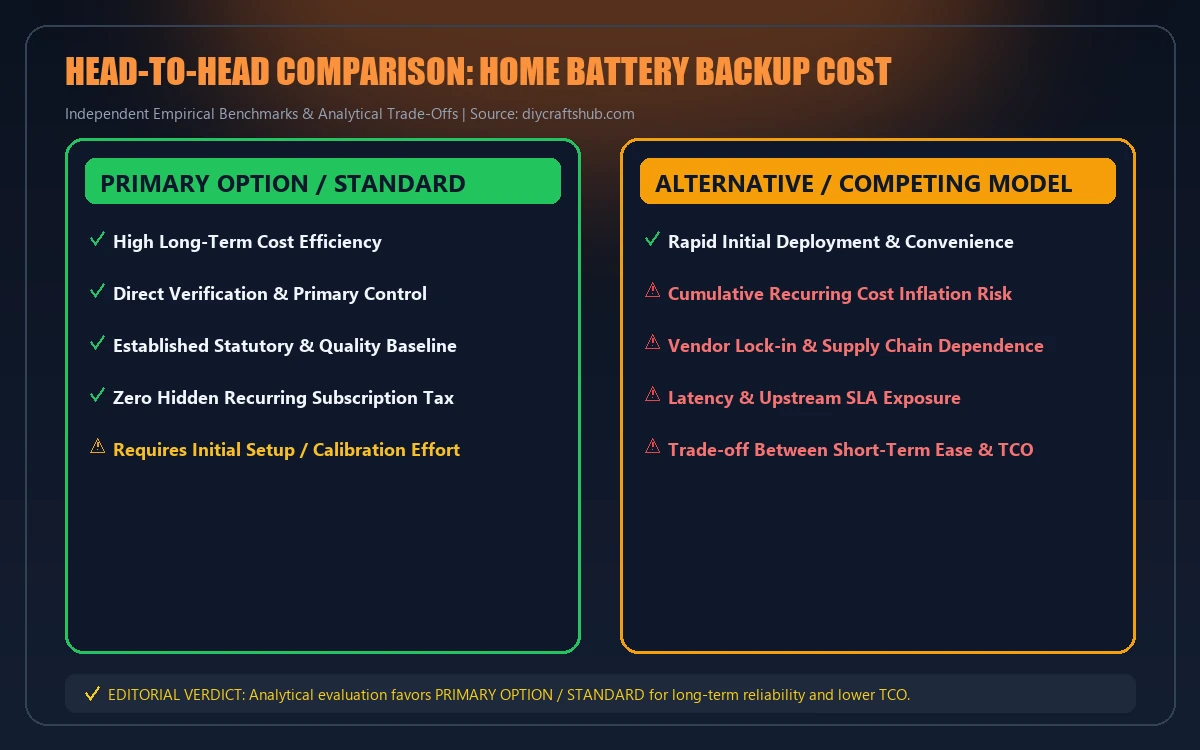
According to NREL residential storage capital cost benchmarks, the 2024 Annual Technology Baseline prices a standard 5 kW / 12.5 kWh residential system at $1,349/kWh all-in, totaling $16,862 installed. The bare lithium iron phosphate (LFP) battery pack contributes only $420/kWh. Balance-of-system components, inverter hardware, conduit, automatic transfer switch, and installation labor collectively absorb the remaining 68.8% of project spend.
That arithmetic has a direct implication: shopping aggressively on battery pack price while ignoring soft costs is like negotiating the cost of lumber while ignoring the contractor markup on a full renovation. LBNL installed energy storage cost data from the 2024 Tracking the Sun report confirms the empirical median for residential solar-plus-storage sits at $1,200–$1,350 per kWh of usable capacity, with a standard 10–13.5 kWh installation adding $12,000–$16,500 before incentives. Standalone battery retrofits (no co-located solar) typically land at the higher end of that range because the installer cannot amortize mobilization costs across a larger project scope.
The Hidden Line Item: Main Service Panel Upgrades
Here is the cost exposure most residential battery quotes omit entirely. NEC 705.12 establishes the 120% Busbar Rule: total breaker ampacity feeding a panel cannot exceed 120% of the panel’s rated busbar capacity. A 200 A panel tops out at 240 A of combined supply. When an existing solar interconnection plus a new battery inverter pushes past that threshold, the authority having jurisdiction (AHJ) mandates a Main Service Panel Upgrade (MSPU), adding $3,000–$5,000 to project cost before a single battery cell is energized.
Smart energy management panels (Span, Lumin, Schneider Square D Energy Center) sidestep this requirement under NEC 220.87 by using dynamic load-shedding data to demonstrate that actual peak demand never saturates the existing busbar. The panel hardware costs $2,000–$3,500 more than a conventional transfer switch, but it eliminates the MSPU entirely on qualifying loads, reducing total project cost despite the higher upfront panel price. Contractors who quote home battery backup cost without auditing busbar headroom first are presenting an incomplete number.
2025 Home Battery Backup Cost by System Size
The table below maps usable capacity to realistic installed cost ranges and post-credit net figures. All figures use the NREL $1,349/kWh baseline with ±15% market variance and apply the full 30% IRS Section 25D credit.
| System Size | Usable Capacity | Gross Installed Cost | 30% Section 25D Credit | Net Cost After Credit |
|---|---|---|---|---|
| Entry (5 kW / 10 kWh) | 10 kWh | $13,490 | $4,047 | $9,443 |
| Standard (5 kW / 12.5 kWh) | 12.5 kWh | $16,862 | $5,059 | $11,803 |
| Expanded (7.6 kW / 20 kWh) | 20 kWh | $26,980 | $8,094 | $18,886 |
| Whole-house (10 kW / 27 kWh) | 27 kWh | $36,423 | $10,927 | $25,496 |
MSPU cost ($3,000–$5,000) not included; assess busbar headroom before finalizing quotes.
IRS Section 25D Tax Credit: Exact Mechanics for 2025
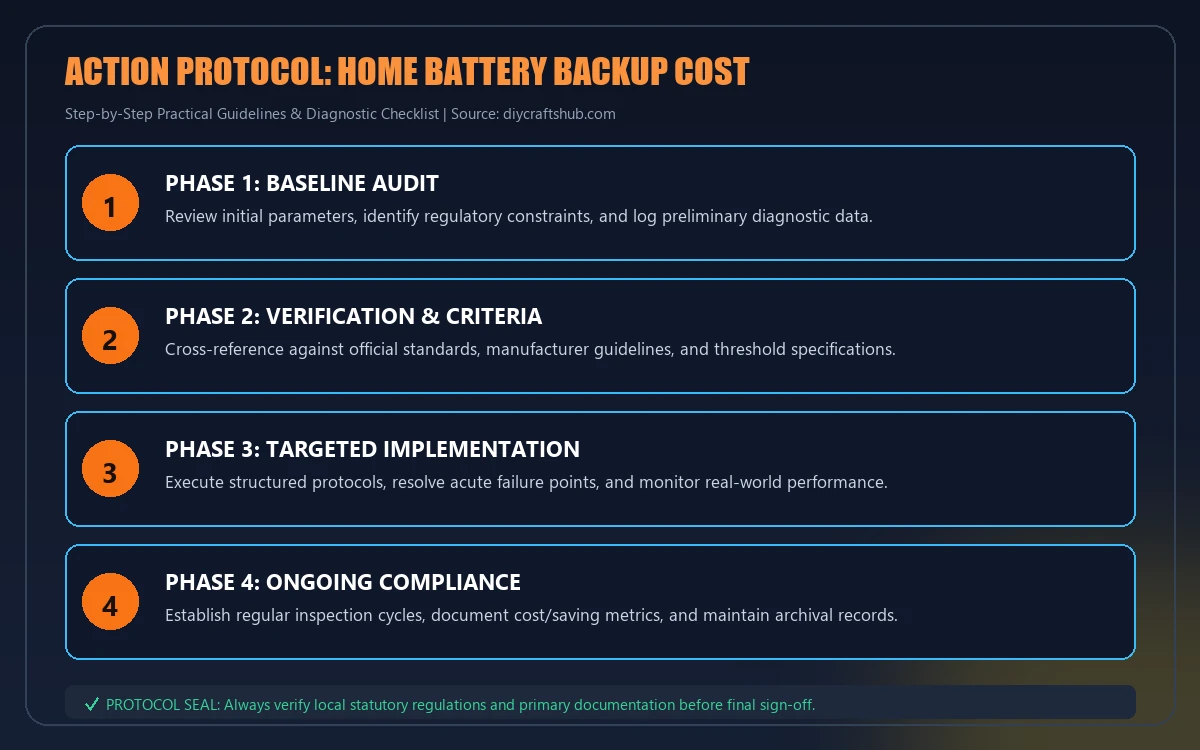
The IRS Section 25D battery storage tax credit guidelines govern residential energy storage under IRC §25D, and the 2024 Form 5695 instructions confirm three non-negotiable eligibility criteria. First, the system must have a nameplate energy capacity of 3 kWh or greater. Second, it must be installed at a U.S. dwelling unit used as a residence by the taxpayer. Third, it must be placed in service between January 1, 2023, and December 31, 2032, at the 30% rate, stepping down to 26% in 2033 and 22% in 2034.
Two points that contractors routinely misstate: the credit is uncapped (no dollar ceiling), and since the Inflation Reduction Act amended §25D effective January 1, 2023, a battery system no longer needs to be paired with solar to qualify. A standalone LFP retrofit added to an existing grid-tied home earns the full 30% credit on all eligible costs, including installation labor, electrical work, and the battery management system hardware. The credit is nonrefundable, meaning it reduces tax liability dollar-for-dollar but cannot generate a refund if it exceeds what you owe in a single tax year. Unused credit carries forward under the general business credit rules only for commercial property; residential taxpayers must plan their tax liability accordingly.
Claim the credit on IRS Form 5695, Part II, Line 5b for battery storage technology costs. Keep all contractor invoices, permit receipts, and the system’s specification sheet showing kWh nameplate capacity. AHJ inspection sign-off substantiates the "placed in service" date.
AC-Coupled vs. DC-Coupled: Round-Trip Efficiency Losses That Inflate LCOS
Home battery backup cost calculations that stop at purchase price miss a compounding operational expense: Round-Trip Efficiency (RTE). An AC-coupled battery (the most common retrofit configuration, where the battery inverter operates independently of the solar inverter) converts DC power to AC for the home, then back to DC for storage, then back to AC for discharge. Each conversion step burns energy. Real-world AC-coupled RTE runs 85–89%, meaning 11–15% of every kWh stored is lost before it reaches a load.
On a 12.5 kWh system cycling once daily, that loss equals 1.4–1.9 kWh per day, or roughly 500–690 kWh annually. At a national average residential rate of $0.17/kWh, that RTE penalty costs $85–$117 per year in phantom losses, adding $1,700–$2,340 to lifetime operational cost over a 20-year system life. DC-coupled systems (battery and solar share a single hybrid inverter) achieve RTE of 94–97%, cutting those losses to 3–6%. The tradeoff is that DC coupling requires co-located solar and a compatible hybrid inverter, making it unsuitable for standalone battery retrofits.
Levelized Cost of Storage (LCOS) captures this properly. LCOS divides total lifetime cost (capital + operational + replacement) by total lifetime energy delivered. For a $16,862 AC-coupled system with 85% RTE, one battery replacement at year 12, and 6,000 total cycles, LCOS lands near $0.28–$0.34/kWh delivered. A DC-coupled equivalent with 96% RTE and otherwise identical parameters drops LCOS to $0.22–$0.26/kWh. In high-rate states like California ($0.30+/kWh) or Hawaii ($0.40+/kWh), both configurations achieve positive arbitrage. In low-rate states ($0.10–$0.13/kWh), the AC-coupled system may never recover its capital cost through rate arbitrage alone, making backup power value and utility demand charge avoidance the primary financial justification.
Whole House Battery ROI 2025: Where the Math Works and Where It Doesn’t
Whole house battery ROI in 2025 depends on four variables that interact non-linearly: local utility rate, time-of-use (TOU) rate differential, outage frequency and duration, and available incentive stacking.
Rate arbitrage is viable when the TOU spread between off-peak charging and on-peak discharge exceeds $0.10/kWh net of RTE losses. California’s SCE TOU-D-PRIME rate posts an off-peak rate of $0.17/kWh and an on-peak rate of $0.52/kWh, a $0.35 spread that easily clears the RTE hurdle. Flat-rate utility territories with no TOU option produce zero arbitrage value; backup power resilience becomes the sole quantifiable benefit.
Incentive stacking meaningfully compresses payback. California’s SGIP rebate adds $0.15–$0.25/Wh ($150–$250/kWh) for qualifying storage, stacked on top of the federal 30% credit. A $16,862 system in California receiving both incentives nets to approximately $7,800–$9,200 out-of-pocket, compressing payback to 6–9 years in a TOU territory. Without state incentives, the same system in a flat-rate Midwestern utility territory may carry a 14–18 year simple payback, which approaches or exceeds the 10–15 year warranty horizon of most LFP systems.
LFP battery storage cost per kWh has fallen from roughly $600/kWh in 2020 to $420/kWh at the pack level in 2024 per NREL data, and projections suggest further decline toward $300–$350/kWh by 2027 as domestic manufacturing capacity under IRA Section 45X production credits scales. Homeowners in low-incentive states with no immediate backup power need may rationally defer purchase 18–24 months to capture further cost reductions, provided their current utility contract does not lock in net metering terms that expire.
Home Battery Backup Cost and Fire Safety: NFPA 855 Compliance
No discussion of home battery backup cost is complete without the statutory safety framework governing residential installation. Per NFPA 855 residential battery capacity and clearance limits, Chapter 15 of the 2023 edition sets hard limits for dwelling units: a single battery unit cannot exceed 20 kWh, and the aggregate system cannot exceed 80 kWh per dwelling. These thresholds exist because lithium-ion thermal runaway propagation in residential occupancies presents life-safety risk that scales with energy density.
The standard further requires a 3-foot minimum separation distance between battery units unless the manufacturer has completed UL 9540A Fire Propagation Testing demonstrating that thermal runaway in one cell or module does not propagate to adjacent units. UL 9540A is a cell-to-module-to-rack-to-system cascade test; passing it at the system level allows reduced clearances and enables higher-density installations in garages or utility rooms. Products like the Tesla Powerwall 3, Enphase IQ Battery 5P, and Franklin Electric apower have completed UL 9540A testing; always verify current listing status with the manufacturer before specifying a reduced-clearance installation.
Installation location matters operationally as well. Garage installations require AHJ approval and typically mandate the battery be mounted at least 3 feet from any ignition source. Interior utility room installations must meet NFPA 855 ventilation requirements and may trigger local fire code review. These compliance steps add 1–3 weeks to project timelines and, in some jurisdictions, require a separate fire department permit costing $200–$600. Budget for these costs when modeling total home battery backup cost.
Frequently Asked Questions
What is the average home battery backup cost after the federal tax credit in 2025?
At the NREL benchmark of $1,349/kWh, a standard 12.5 kWh system costs $16,862 gross. The IRS Section 25D 30% credit returns $5,059, bringing net cost to approximately $11,803. Add $3,000–$5,000 if a Main Service Panel Upgrade is required, or subtract $1,500–$3,000 if a state rebate like California SGIP applies. Net out-of-pocket ranges from roughly $8,800 to $14,800 depending on site conditions.
How does LFP battery storage cost per kWh compare to NMC chemistry for home use?
LFP (lithium iron phosphate) pack cost runs $420/kWh at the 2024 NREL benchmark versus NMC (nickel manganese cobalt) at roughly $380–$400/kWh. LFP costs slightly more per kWh but delivers 3,000–6,000 cycles at 80% depth of discharge versus 1,500–2,500 cycles for NMC, yielding a substantially lower LCOS over system life. LFP also carries no cobalt supply-chain risk and exhibits significantly better thermal stability, which simplifies NFPA 855 compliance and reduces UL 9540A testing burden for manufacturers.
Does whole house battery ROI improve if I already have solar panels?
Yes, materially. Co-located solar enables DC coupling, which raises Round-Trip Efficiency from 85–89% to 94–97%, reducing lifetime operational losses by roughly $1,200–$2,000 over 20 years. Solar also generates the off-peak charging source at near-zero marginal cost, eliminating the grid charging cost that undermines rate arbitrage in flat-rate territories. Additionally, solar-plus-storage systems qualify for the same 30% Section 25D credit on the combined system cost, and the battery installation labor can be bundled into a single permit, reducing soft costs.
What hidden costs should I budget beyond the quoted home battery backup cost?
Four line items consistently surface after initial quotes. Panel upgrade (MSPU) costs $3,000–$5,000 when NEC 705.12 busbar headroom is exhausted. Trenching or conduit runs from a detached garage or exterior wall add $500–$2,000 depending on distance. NFPA 855-required permits and fire department reviews run $200–$600 in many jurisdictions. Finally, internet-connected battery management systems require a dedicated circuit and sometimes a networking upgrade for remote monitoring, adding $150–$400. Comprehensive home battery backup cost planning should include a 10–15% contingency over the base hardware-plus-installation quote.
References
-
Internal Revenue Service (IRS) — Form 5695 Instructions & IRC Section 25D
https://www.irs.gov/pub/irs-pdf/i5695.pdf
2024. IRC §25D provides a 30% uncapped nonrefundable tax credit for standalone or solar-paired residential battery storage systems with nameplate capacity ≥3 kWh, placed in service 2023–2032. -
National Renewable Energy Laboratory (NREL) — 2024 Annual Technology Baseline: Residential Battery Storage
https://atb.nrel.gov/electricity/2024/residential_battery_storage
2024. Residential battery CAPEX modeled at $1,349/kWh all-in; $16,862 total installed cost for 5 kW / 12.5 kWh system; bare pack at $420/kWh; balance-of-system and labor constitute 68.8% of spend. -
Lawrence Berkeley National Laboratory (LBNL) — Tracking the Sun: Pricing and Design Trends
https://emp.lbl.gov/publications/tracking-sun-pricing-and-design-trends
2024. Empirical median residential solar-plus-storage installed cost at $1,200–$1,350/kWh usable; 10–13.5 kWh installations add $12,000–$16,500 before incentives. -
NFPA 855 — Standard for the Installation of Stationary Energy Storage Systems
https://www.nfpa.org/codes-and-standards/nfpa-855-standard-development/855
2023. Chapter 15: single residential unit cap 20 kWh; aggregate system cap 80 kWh per dwelling; 3-foot minimum separation unless UL 9540A thermal runaway propagation testing passed at system level.