Written by: Home & Building Editorial Team (Residential Systems & Maintenance Desk)
Reviewed by: Home Systems Review Desk (Building Code & Specification Review)
Editorial Standard: Residential Reference Guide | Primary Source Verified — Cross-referenced with published building guidelines, manufacturer manuals & energy standards
Editorial Verification Standard: Technical parameters, comparative benchmarks, and procedural steps are cross-checked against primary documentation and published standards.
Woodcraft store beginner classes cost between $75 and $150 for foundational single-session modules (3 to 5 contact hours). Multi-day comprehensive intensives range from $200 to $400 (8 to 16 contact hours). Tuition includes surfaced hardwood stock, consumable abrasives, blade wear, direct access to commercial machinery ($10,000+ per workstation), and hands-on guidance from veteran woodworkers. Real value lies in bypassing steep capital expenditure hurdles, mitigating physical injury hazards, and eliminating costly stock-ruining joinery errors.
Executive Summary & Direct BLUF: Woodcraft Joinery Class Cost and Real ROI
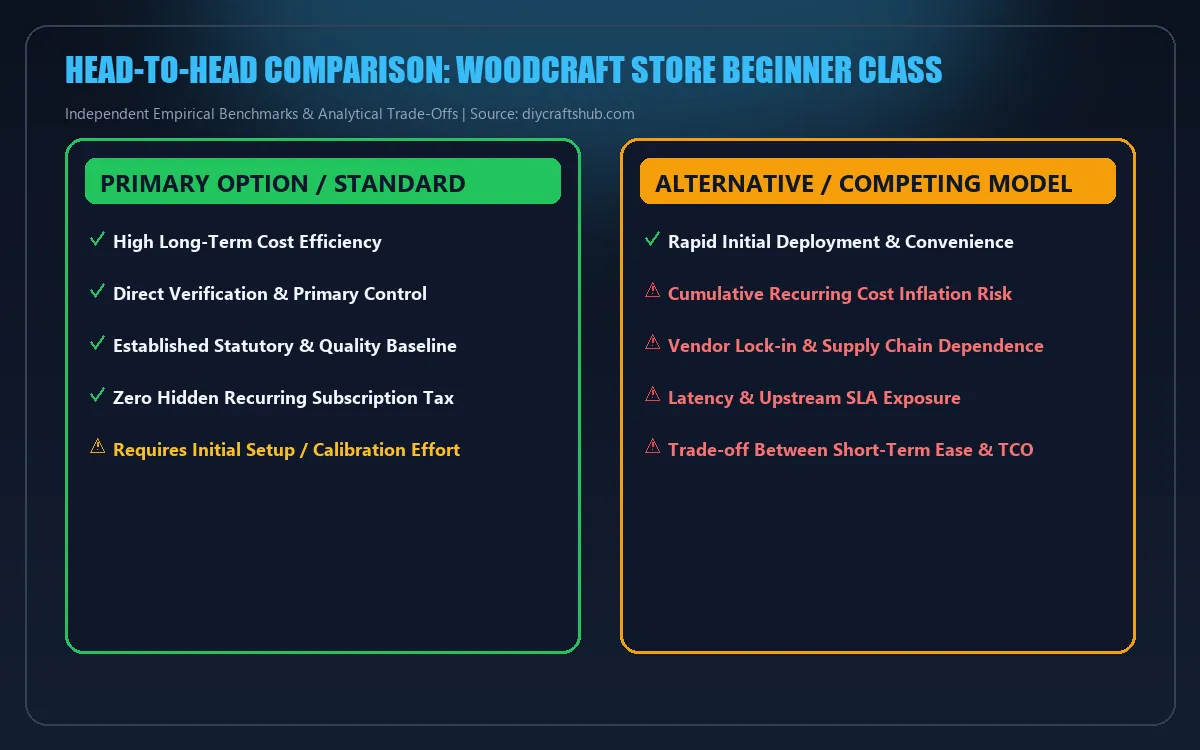
Woodcraft joinery curriculum divides into two tiers: basic introductory joinery seminars and master-level multi-day workshops. Understanding exact retail pricing structures clarifies capital return metrics.
+---------------------------------------------------------------------------------------+
| WOODCRAFT JOINERY TUITION BREAKDOWN                                                   |
+--------------------------+-----------------+---------------+--------------------------+
| Tier                     | Price Range     | Contact Hours | Cost Per Hour Benchmark  |
+--------------------------+-----------------+---------------+--------------------------+
| Single-Session Basics    | $75 - $150      | 3 - 5 Hours   | $22.00 - $30.00 / hr     |
| Multi-Day Intensives     | $200 - $400     | 8 - 16 Hours  | $20.00 - $28.00 / hr     |
| Specialized Masterclasses| $350 - $650     | 16 - 24 Hours | $21.80 - $29.50 / hr     |
+--------------------------+-----------------+---------------+--------------------------+
Students pay entry tuition verified through official Woodcraft store class registration schedules. Baseline fee covers raw materials, shop power, blade sharpening allocations, consumable adhesives, finishing media, and instructional labor.
Tool Capital Offset Analysis
Beginner setting up functional home joinery shop faces catastrophic upfront capital barrier. Basic joint production requires four machine classes plus hand-tool infrastructure:
- Cabinet saw with flesh-detecting safety mechanism (SawStop Professional Cabinet Saw, 3 HP): $3,450.
- Parallelogram jointer with helical cutterhead (8-inch, 2 HP): $2,400.
- Stationary thickness planer with spiral head (15-inch, 3 HP): $2,800.
- Dedicated hollow-chisel mortiser or heavy-duty plunge router with mortising jig: $650.
- Hand tool package: Premium bench chisels (1/4", 3/8", 1/2", 3/4"), Japanese or Western dovetail saws, combination square, marking gauges: $650.
- Two-stage cyclonic dust collection system (2 to 3 HP, ductwork included): $2,100.
Total minimum capital expenditure to build home baseline exceeds $12,050. Tuition payment of $120 to learn joinery fundamentals saves initial capital investment. Student tests workflow ergonomics, assesses physical tool tolerances, and confirms commitment before buying machinery.
Raw Hardwood Loss Mitigation
Novice joiners waste significant stock during dimensioning and joint cutting. Current pricing for kiln-dried 4/4 FAS domestic hardwoods (FAS grade, S2S or rough-sawn) sits high:
- Black Walnut (Juglans nigra): $14.50 to $19.00 per board foot.
- White Oak (Quercus alba): $9.50 to $13.00 per board foot.
- Hard Maple (Acer saccharum): $8.00 to $11.50 per board foot.
- Cherry (Prunus serotina): $7.50 to $10.00 per board foot.
Standard project consuming 15 board feet of white oak costs $142.50 in raw stock alone. Cutting tenons out of square, mortising off centerline, or blowing out dovetail baselines renders expensive stock unusable. Tuition directly pays for test lumber. Student transfers fabrication failures to practice stock funded by enrollment fee.
Core Joinery Framework, Safety Mandates, and Instructional Standards
Instruction centers on mechanical integrity, wood grain physics, machine tooling tolerances, and personal protection.
Primary Joinery Mechanical Principles
Class curriculums cover three structural joinery methodologies:
      MORTISE & TENON                      DOVETAIL JOINT                 POCKET HOLE JOINT
   +-------------------+               +-------------------+             +-----------------+
   |      Tenon        |               |    Tail    Pin    |             |  Fastener Axis  |
   |   +-----------+   |               |   |\    /|   /|   |             |   \ 15° Angle   |
   |   | Cheek     |   |               |   | \  / |  / |   |             |    \            |
   |===|===========|===|               |===|==\/==|==/=|===|             |=====\===========|
   |   | Shoulder  |   |               |   Baseline        |             |      \ (Screw)  |
   +---+-----------+---+               +-------------------+             +-------v---------+
   Shear Load / Racking Resist         Tensile Strength Across End Grain  Face-Frame Compression
1. Mortise-and-Tenon Framework
Standard structural joint for load-bearing leg-and-rail assemblies.
- Rule of Thirds: Tenon thickness must equal one-third rail thickness (nominal 3/4" rail requires 1/4" tenon).
- Cheek Clearance: Friction fit requires lateral tolerance of +0.002" to +0.004". Joint must slide under light hand pressure without mallet impact, leaving microscopic film space for polyhydroxy adhesive (PVA glue).
- Shoulder Geometry: Square 90.00-degree shoulder seats against mortise face. Blocks twisting under rotational torque.
2. Dovetail Joinery (Through and Half-Blind)
Standard joint for drawer boxes and case construction.
- Mechanical Interlock: Relies on wedge geometry, not adhesive bond alone. Resists tensile separation along axis of pull.
- Slope Ratios: Hardwoods run 1:8 slope (7.1 degrees); softwoods run 1:6 slope (9.5 degrees).
- Anisotropic Expansion Accounting: Solid stock shifts along tangential and radial dimensions. Grain alignment must run parallel across corner assemblies. According to USDA Wood Handbook shrinkage standards, tangential-to-radial shrinkage differential averages 2:1 in domestic hardwoods, while unsealed end grain absorbs moisture 10 to 15 times faster than radial face stock. Poor joint orientation causes cross-grain splitting as atmospheric relative humidity fluctuates.
3. Pocket Hole Fastening Systems
Mechanical face-frame assembly method.
- Geometry: Drill pilot guide sets 15-degree attack angle. Stepped drill bit forms 3/8" counterbore and 1/8" pilot shank.
- Fastener Mechanics: Self-tapping case-hardened screws draw components into dynamic compression.
- Grain Limitation: Pocket screws hold strongly across side-grain connections, but strip out when driven directly into end-grain fibers without reinforcement.
Rigorous Safety Mandates & Industrial Hygiene
Woodcraft shops operate under industrial machinery guidelines.
WARNING: Mechanical Point-of-Operation Safety Mandates
Rotating cutterheads and saw blades inflict catastrophic, irreversible trauma in milliseconds. All operations must follow these exact protocols without deviation:
- Disconnect machine power lockout before changing blades, adjusting cutterheads, or measuring blade clearances.
- Maintain minimum safe hand clearance of 4 inches (101.6 mm) from active cutting circles on table saws and shapers; maintain 6 inches (152.4 mm) on jointers.
- For stock under 12 inches (304.8 mm) in length, or under 3 inches (76.2 mm) in width, use mechanical hold-down push blocks and featherboards. Never hand-feed small stock.
- Ensure jointer cutterheads have spring-loaded automatic guards that cover the entire cutter block before, during, and after stock passes.
- Set table saw riving knives within 0.12 to 0.31 inches (3 to 8 mm) of the blade perimeter to eliminate workpiece binding and violent kickback.
These protocols enforce statutory machinery controls defined in OSHA 1910.213 machine safety mandates.
Respirable Particulate Mitigation
Respirable wood dust (aerodynamic diameter < 10 microns) triggers pulmonary sensitization and chronic airway inflammation. Toxic extractives in hardwoods (Dalbergia, Juglans) cause severe contact dermatitis and acute rhinitis.
- Shop ventilation must meet NIOSH industrial ventilation specifications.
- Branch ducts require minimum capture velocity of 4,000 feet per minute (fpm) at cutterhead collection hoods. Main collection ducts require 3,500 fpm transport velocity.
- Air cleaning requires two-stage cyclonic filtration with HEPA secondary cartridges capable of capturing 99.97% of particles down to 0.3 microns.
- Instruction requires tight-fitting elastomeric respirators (N95 or P100 rated) during sanding and routing sessions.
Instructional Standards and Instructor Benchmarks
Instruction quality determines class value. Woodcraft maintains strict instructor qualifications:
- Instructor pool draws from professional furniture makers, master carpenters, architectural millworkers, and guild leaders.
- Instructors must hold minimum 10 years verified practical shop experience or fine woodworking degree/certificate.
- Instructors undergo curriculum standardization. Lessons emphasize structural geometry, repeatable machine setups, test-cut methodology, and safety compliance.
- Commercial benchmark: Median professional cabinetmaker wage sits at $20.48 per hour according to BLS woodworking industry wage metrics. Retail student costs ($20 to $30/hour) fund both experienced instructor compensation and expensive shop overhead.
Empirical Benchmarks: Woodcraft Tuition vs. Competitors & Community Guilds
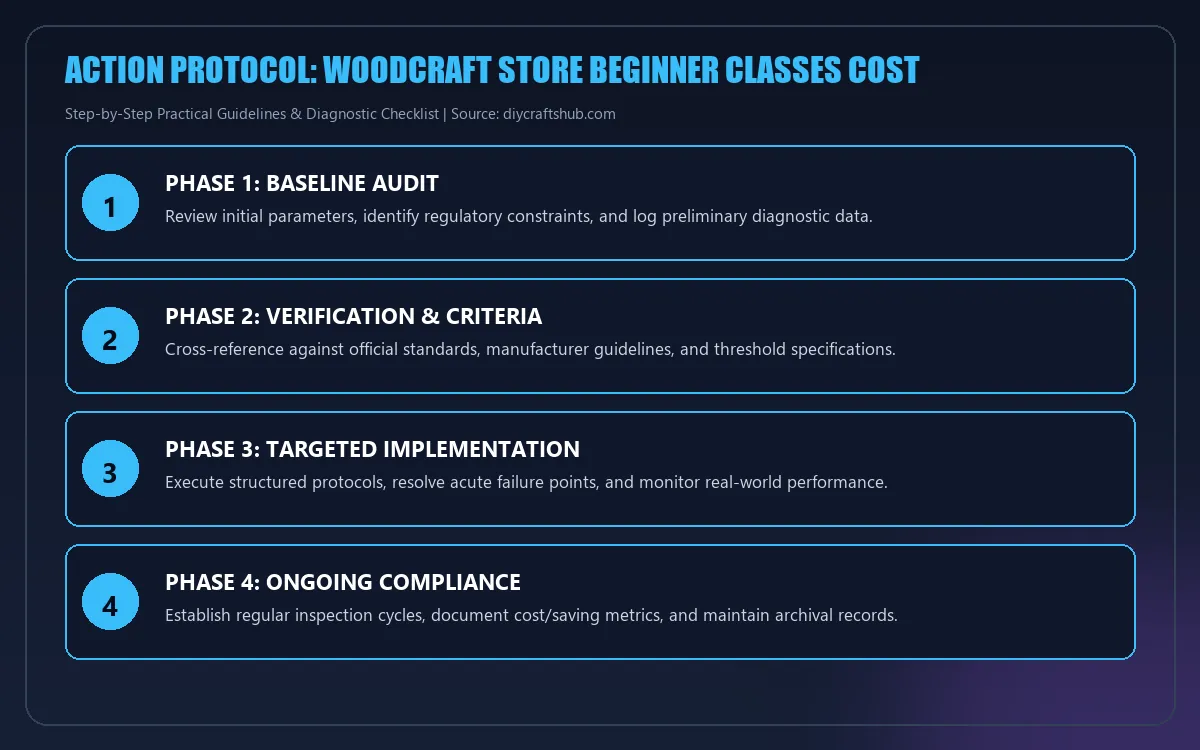
Evaluating class economics requires clear comparative data across regional woodworking supply retailers, non-profit community makerspaces, and accredited craft schools.
+-----------------------------------------------------------------------------------------------------------------------------------------+
| SYSTEM COMPARISON: WOODWORKING INSTRUCTIONAL PROVIDERS                                                                                  |
+---------------------+-------------------+-----------------+-------------------+----------------------+---------------+------------------+
| Facility / Provider | Hourly Rate Range | Standard Format | Lumber Included   | Machine Spectrum     | Student-Ratio | Prerequisite Reg |
+---------------------+-------------------+-----------------+-------------------+----------------------+---------------+------------------+
| Woodcraft Retail    | $20 - $30 / hr    | 3 - 8 hr modules| Yes (FAS Grade)   | Heavy Commercial     | 4:1 to 6:1    | None (Beginner)  |
| Store Classes       |                   | Weekend focus   | S4S / Pre-milled  | SawStop, Powermatic  |               | Core Safety Gate |
+---------------------+-------------------+-----------------+-------------------+----------------------+---------------+------------------+
| Rockler Retail      | $22 - $35 / hr    | 3 - 5 hr project| Yes (Proprietary  | Mid-to-Heavy Comm.   | 3:1 to 5:1    | None (Beginner)  |
| Competitor Seminars |                   | Make-and-take   | Kits / Blanks)    | SawStop, Laguna      |               | In-Class Waiver  |
+---------------------+-------------------+-----------------+-------------------+----------------------+---------------+------------------+
| Community Makerspace| $12 - $20 / hr    | Monthly Access  | No (B.Y.O. Lumber)| Mixed Light/Mid Comm.| Variable      | Mandatory Safety |
| Non-Profit Guilds   | + Dues ($60-150/m)| + Sign-off class| Extra Surcharge   | Grizzly, Jet, Delta  | 8:1 to 15:1   | Tool Clearance   |
+---------------------+-------------------+-----------------+-------------------+----------------------+---------------+------------------+
| Accredited Regional | $35 - $60 / hr    | 1 - 2 Week      | Partial / Extra   | Production Grade     | 6:1 to 10:1   | Staged Sequence  |
| Folk / Craft Schools| ($900 - $1,800)   | Full Immersive  | Lab Fees ($150+)  | Martin, Felder, SCM  | Dedicated     | Rigorous Pre-Req |
+---------------------+-------------------+-----------------+-------------------+----------------------+---------------+------------------+
Comparative Analysis of Value Vectors
1. Woodcraft vs. Rockler Retail Model
Both commercial retailers offer similar instructional setups.
- Curriculum Focus: Rockler classes favor proprietary jigs (dowel jigs, beadlock systems, pocket hole jigs) and fast project turnarounds ("Make and Take" cutting boards, pens, small boxes). Woodcraft curriculum stresses broad joinery fundamentals: traditional mortise-and-tenon cutting on stationary equipment, hand-cut and router-cut dovetails, and grain-matching strategies.
- Lumber Integration: Woodcraft includes raw domestic hardwoods directly off retail racks. Students observe stock selection, inspecting grain orientation, warp, twist, and bow. Rockler often relies on pre-dimensioned stock kits, reducing student stock-prep experience.
2. Woodcraft vs. Community Makerspaces and Tool Guilds
- Overhead Cost Structure: Makerspaces require ongoing monthly memberships ($60 to $150 per month) plus tool checkout fees. Beginner woodworkers must pay membership dues for 3 to 6 months to master basic joints. Total initial cost reaches $300 to $900 before completing first project.
- Equipment Integrity: Makerspaces suffer from shared tooling wear. Dull blades, warped miter gauges, out-of-square fences, and broken router collars are common. Woodcraft classrooms maintain dedicated machinery banks inspected and calibrated daily by store technical staff.
3. Woodcraft vs. Regional Fine Woodworking Craft Schools
- Tuition Shock: Institutions like Marc Adams School of Woodworking or North Bennet Street School deliver elite master instruction. Entry barrier is high: $900 to $1,800 weekly tuition, plus housing, travel, and supply fees.
- Application Space: High-end craft schools suit advanced hobbyists pursuing professional studio craftsmanship. Woodcraft entry modules serve suburban home builders, weekend makers, and residential renovators looking to build joinery competency without taking leave or incurring four-figure travel costs.
Student-to-Teacher Ratio Impact on Skill Acquisition
Student density directly impacts safety, machine access time, and joinery accuracy:
RATIONALE: DIRECT ACCESS MINUTES PER 4-HOUR CLASS (240 MINUTES TOTAL)
Assumes 60 minutes lecture/demo, leaving 180 minutes machine run-time split across cohort.

+-------------------------------+-----------------------+-----------------------------+
| Cohort Size                   | Hands-On Tool Access  | 1-on-1 Instructor Mentoring |
+-------------------------------+-----------------------+-----------------------------+
| Woodcraft Model (4 Students)  | 45.0 Minutes / Machine| 30.0 Minutes / Student      |
| Woodcraft Model (6 Students)  | 30.0 Minutes / Machine| 20.0 Minutes / Student      |
| Makerspace Model (12 Students)| 15.0 Minutes / Machine| 10.0 Minutes / Student      |
| Guild Seminar (16 Students)   | 11.25 Minutes/ Machine|  7.5 Minutes / Student      |
+-------------------------------+-----------------------+-----------------------------+
Woodcraft enforces strict 4:1 to 6:1 student-to-teacher caps. Low density guarantees high instructor intervention rates. Instructors correct improper stance, chisel bevel tilt, stock feed rate, and hands-over-cutter errors before stock ruins or kickbacks occur. Small cohort sizes justify the class cost, giving beginners dedicated machine access, safe conditions, and real skill growth.
Practical Enrollment and Skill-Extraction Protocol
Class schedules publish on rolling 30-day to 60-day cycles per franchise. Access official Woodcraft store class registration schedules directly through local branch portals. Open slots fill fast. High-demand weekend courses hit capacity four weeks before start dates.
Step-by-Step Workshop Preparation and In-Shop Execution
For maximum skill retention and physical shop safety, execute the following preparation protocol sequentially:
- Verify prerequisite technical clearances: Contact store education coordinator 14 days before start date. Confirm syllabus expectations. If course covers mortise-and-tenon or dovetail operations, verify whether instructor expects pre-existing mastery of stationary jointers, planers, and bandsaws, or if machine orientation occurs during class hours.
- Inspect personal protective equipment (PPE): Procure ANSI Z87.1-certified wrap-around safety glasses. Non-certified reading glasses fail impact requirements. Acquire dual-cartridge half-mask respirator rated N95 or P100. Retail store central collection frequently runs below NIOSH industrial ventilation specifications target of 4,000 feet per minute capture velocity at machine branch ports. Pack passive ear protection with minimum Noise Reduction Rating (NRR) of 25 dB.
- Audit provided stock dimensions: Confirm raw material distribution. Standard courses provide S4S (surfaced four sides) lumber. Verify board thickness measures uniform within 0.010 inch across full length. If material shows cup, bow, or twist exceeding 0.030 inch, request replacement blank before layout steps start.
- Inspect bench station edge tooling: On arrival, inspect assigned bench chisels. Flatness of chisel back determines joinery reference accuracy. Test edge on end-grain scrap. If tool crushes wood fibers rather than severing clean shavings, demand shop waterstones (1,000/6,000 grit progression) to hone 30-degree secondary micro-bevel before cutting workpieces.
- Enforce machine boundary conditions: Adhere strictly to OSHA 1910.213 machine safety mandates. Never pass stock under 12 inches length through jointer without push blocks. Maintain 3-inch operator safety margins from circular saw blades and shaper cutterheads.
- Execute test joints in sacrificial lumber: Mark layout lines with striking knife, not carpenter pencil. Knife line severs outer fibers, preventing grain tearout during crosscut and chisel paring steps. Complete full trial joint in matching test scrap. Verify shoulder seating and tenon cheek friction before cutting final project parts.
Lumber Optimization and Grain Physics
Joinery strength depends on species selection and growth ring alignment. Retail workshops stock domestic hardwoods: Poplar (Liriodendron tulipifera), Soft Maple (Acer rubrum), Red Oak (Quercus rubra), and Black Cherry (Prunus serotina).
Select quarter-sawn stock for tenons and through-dovetails. Quarter-sawn boards show growth rings perpendicular to wide face (60 to 90 degrees). Wood expands across grain, never along length. Per USDA Wood Handbook shrinkage standards, domestic hardwoods exhibit tangential-to-radial shrinkage ratio averaging 2:1. Flat-sawn lumber cups across face during humidity swings. Quarter-sawn stock expands uniformly through thickness, keeping joint pins and mortise cheeks locked under mechanical friction without glue-line failure.
Inspect grain runout along board edges. Grain sloping off parallel axis exceeds 1:12 angle produces tearout during hand-planing and router passes. Reject blanks with knots within 4 inches of planned mortise locations. Knots introduce localized grain swirl, causing chisel edges to deflect off layout marks.
+------------------+-----------------------+--------------------+---------------------+
| Species          | Tangential Shrink (%) | Radial Shrink (%)  | Recommended Joint   |
+------------------+-----------------------+--------------------+---------------------+
| Poplar           | 8.2                   | 4.6                | Practice / Lap      |
| Soft Maple       | 7.1                   | 3.7                | Pocket / Dowel      |
| Red Oak          | 8.6                   | 4.0                | Mortise & Tenon     |
| Black Cherry     | 7.1                   | 3.7                | Half-Blind Dovetail |
| Black Walnut     | 7.8                   | 5.5                | Through Dovetail    |
+------------------+-----------------------+--------------------+---------------------+
Maximize bench time. Arrive 20 minutes early. Zero machine fences. Align tablesaw miter gauge to slot using dial indicator. Verify 90-degree stops before instructor demonstration begins. Ask instructor to audit cut sequences rather than general theory. Request immediate critique on chisel hand posture, mallet striking pressure, and stance mechanics.
Diagnostic Considerations, Hidden Expenses, and Skill Failure Points
Analyzing total retail class investment requires looking past posted tuition. While headline woodcraft store beginner classes cost figures range from $85 to $195, ancillary expenditures alter real per-hour economics.
Tuition Base Fee:               $125.00 (Median 4-hour slot)
Mandatory Material Fee:         $ 35.00 (Hardwood blank package)
Required Student Tool Kit:      $ 48.00 (Marking knife, 6" rule, PPE pack)
Consumables Surcharge:          $ 12.00 (Shop sandpaper, adhesives, blades)
----------------------------------------------------------------------------
Real Capital Outlay:            $220.00 ($55.00 per instructional hour)
Analyze fee against market labor. BLS woodworking industry wage metrics report median cabinetmaker wage at $20.48 per hour. Student pays 2.5x to 3x market journeyman labor rate for class seat. Cost justifies only if student extracts critical technical fundamentals impossible to learn safely from digital video channels.
Structural Joinery Failure Analysis
Beginner joinery fails along predictable mechanical lines:
[Tool Dull / Flat-Bevel Missing]
       --> Operator Applies High Mallet Force
       --> Blade Wanders Past Gauge Line
       --> Mortise Wall Crushes Internally
       --> Joint Looses Friction Fit

[Marking with 0.5mm Pencil]
       --> Layout Line Width Measures 0.020"
       --> Saw Cut Straddles Center
       --> Tenon Undersized by 0.015"
       --> Glue Fails to Bridge Gap (PVA gap maximum = 0.004")
Mortise Wall Collapse from Cross-Grain Cleaving
Mortise cuts require chopping perpendicular to wood grain. If mortise ends chopped before waste center cleared, wood acts as wedge. Internal hydraulic pressure splits side walls along grain lines.
Correction: Drill out mortise core on drill press using Forstner bit sized 1/16 inch under mortise width. Pare remaining side walls with wide bench chisel registered against side reference face. Never drive chisel into solid wood without relief hole adjacent.
Chisel Edge Failure and Micro-Fracture
Students often use factory-ground chisels straight out box. Factory grind leaves 25-degree primary bevel covered in machine grind scratches, with unlapped back. Driving thin, unpolished edge into kiln-dried white oak causes edge rolling within three mallet strikes.
Correction: Lap back flat to mirror polish on diamond plate or waterstone up to 8,000 grit. Grind 25-degree primary bevel, then hone 30-degree micro-bevel on tip. Secondary bevel creates stout cutting wedge. Polish removes serrations, distributing impact forces across solid steel cross-section.
Return-on-Investment Diagnostic Matrix
Before booking, calculate financial break-even against home shop outfitting:
+-------------------------+-------------+-----------------------+---------------------------+
| Metric                  | Value       | Alternative Cost      | ROI Assessment            |
+-------------------------+-------------+-----------------------+---------------------------+
| 3-Class Joinery Track   | $450 - $600 | $1,200 (Contractor    | Immediate positive ROI:   |
| (Foundations + Dovetail |             | Saw + Joiner + Dust   | Access to commercial iron |
| + Mortise/Tenon)        |             | Collector purchase)   | without capital outlay.   |
+-------------------------+-------------+-----------------------+---------------------------+
| Tool Wear & Consumables | Included in | $150 (Replacement saw | High efficiency: Shop     |
| (Abrasives, Blades)     | shop fee    | blades, CBN wheels)   | absorbs tool sharpening   |
|                         |             |                       | and maintenance costs.    |
+-------------------------+-------------+-----------------------+---------------------------+
| Scrapped Hardwood Stock | Included or | $80 - $120 per 20 BF  | High efficiency: Student  |
| Allowance               | low markup  | FAS lumber stock      | wastes store test stock,  |
|                         |             |                       | not home inventory.       |
+-------------------------+-------------+-----------------------+---------------------------+
| Bad Habit Correction    | Real-time   | Variable (Failed glue | Incalculable value: Stops |
| Velocity                | instructor  | joints, shop injury,  | unsafe machine operations |
|                         | correction  | broken router bits)   | before permanent muscle   |
|                         |             |                       | memory develops.          |
+-------------------------+-------------+-----------------------+---------------------------+
Frequently Asked Questions
Are personal tools required, or does store inventory supply all bench chisels, hand planes, and safety gear?
Store supplies stationary power tools, workbenches, and standard hand tooling for student stations. However, tool quality varies by franchise branch. Assigned chisels and hand planes frequently show dull irons, nicked cutting edges, or out-of-flat soles from previous student misuse. Bring personal ANSI Z87.1 safety glasses, hearing protection, 6-inch precision square, striking knife, and personal set of 1/4-inch, 1/2-inch, and 3/4-inch bevel-edge bench chisels. Personal tools ensure consistent edge performance, letting student focus on layout mechanics rather than fighting compromised store inventory.
What cancellation and refund options exist if schedule conflicts arise before session start date?
Woodcraft operating policies require class cancellations minimum 7 to 14 days before scheduled event for full refund or credit transfer. Late dropouts inside 7-day window forfeit tuition fee. Franchise owner purchases lumber stock and commits instructor wages based on enrolled headcount. If store cancels session due to low enrollment—typically fewer than three registrants, store issues 100% cash refund or provides direct seat transfer to future calendar block. Confirm specific franchise drop dates on invoice receipt.
Can novice woodworkers operate stationary jointers, planers, and table saws without prior experience?
Yes. Beginner joinery courses start with comprehensive 30 to 45-minute machinery orientation covering feed speeds, push stick selection, blade guard deployment, and kickback mitigation. Instructors observe individual operations directly during initial rough-dimensioning steps. If table saw or shaper operations trigger anxiety, inform instructor before power switches engage. Instructors demonstrate cuts, supervise hand placement, or mill initial stock until student gains mechanical confidence.
Do class enrollments include retail merchandise discounts on tools, hardware, and raw hardwood lumber?
Most franchise locations issue registered students 10% discount card valid on retail store purchases during class day or immediately following course completion. Discount applies to hand tools, hardware, finishing supplies, and lumber racks. Discount excludes major stationary machinery, motorized power tools from price-controlled brands (like Festool, SawStop, or Laguna), and items already marked on clearance. Audit current home shop equipment gaps before class starts to leverage material and hand tool discounts before coupon code expires.
References
- National Institute for Occupational Safety and Health (NIOSH). (2024). Wood Dust Control Guidelines: Hazard Control HC10. Centers for Disease Control and Prevention. https://www.cdc.gov/niosh/docs/hc10/default.html
- Occupational Safety and Health Administration (OSHA). (2024). General Industry Safety and Health Regulations: Woodworking Machinery Requirements (29 CFR 1910.213). U.S. Department of Labor. https://www.osha.gov/laws-regs/regulations/standardnumber/1910/1910.213
- U.S. Bureau of Labor Statistics (BLS). (2024). Occupational Outlook Handbook: Woodworkers. U.S. Department of Labor. https://www.bls.gov/ooh/production/woodworkers.htm
- USDA Forest Service Forest Products Laboratory. (2021). Wood Handbook: Wood as an Engineering Material (General Technical Report FPL-GTR-282). U.S. Department of Agriculture. https://www.fs.usda.gov/research/treesearch/62200
- Woodcraft Supply, LLC. (2024). Woodcraft University Educational Classes and Course Catalog. Woodcraft Franchise Systems. https://www.woodcraft.com/pages/classes